


When planning a large event, headset systems might not seem at the top of your list of major decisions.
Yet the type of headsets you use and their functionality can impact nearly every aspect of your event, from venue logistics and guest experiences to speakers and exhibit hall vendors.
Tour headsets, silent-conference headsets, interpretation channels or a more structured assistive listening setup can help make events more professional and effective.
This article will answer the top questions about headsets used for large events and help you determine next steps.
Audio Headset Planning Challenges for First-time Event Planners
Most first-time planners are introduced to headset systems by scrolling through a product catalog rather than first examining their event workflows.
And when they stare at the screen, terms like transmitters, receivers, channels, one-way audio, interpretation, silent sessions and assistive listening create confusion. Before getting bogged down with features, it’s important to first define the communication experience the event requires.
For example, consider how differently the following scenarios can be treated:
- A noise-reduction rated tour headset system may be exactly right for a plant tour and completely wrong for a silent breakout
- A multilingual listening setup may be essential for one audience with international guests and completely unnecessary for another
- A headset solution may improve the experience dramatically in one format and add unnecessary complexity in another
When the audio headset equipment isn’t matched to the desired guest experience, that’s when issues arise, including:
- Guests miss key information
- Tours feel disjointed
- Sessions lose focus
- Audiences strain to hear
- Staff improvises around avoidable friction
The best way to avoid these outcomes is to get answers to the following important questions.
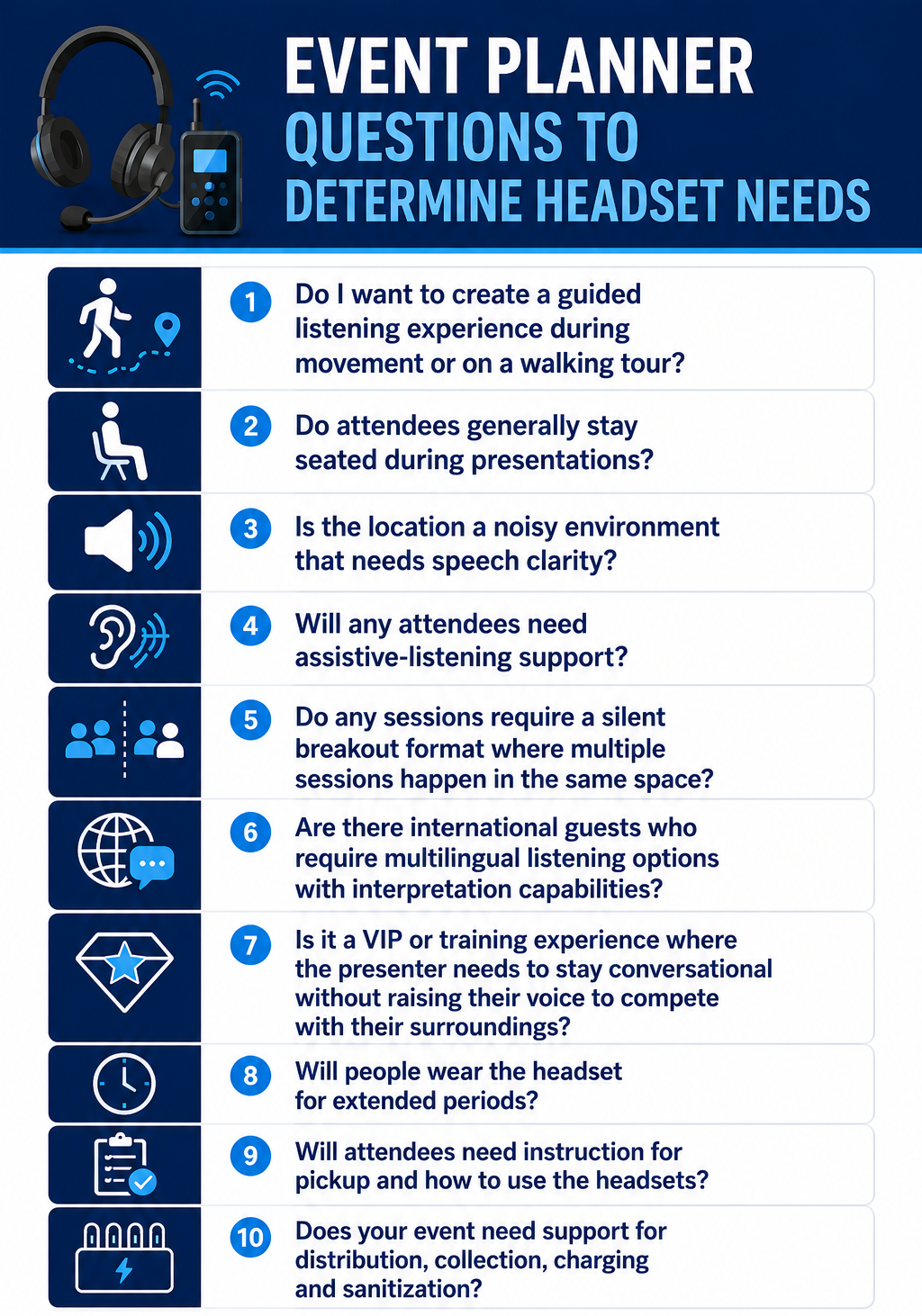
10 Questions Event Planners Should Ask to Determine Headset Needs?
Set aside the urge to compare device specs and features, and start by asking questions that help define the event experience you want to create. Here are a few to get you started:
- Do I want to create a guided listening experience during movement or on a walking tour?
- Do attendees generally stay seated during presentations?
- Is the location a noisy environment that needs speech clarity?
- Will any attendees need assistive-listening support?
- Do any sessions require a silent breakout format where multiple sessions happen in the same space?
- Are there international guests who require multilingual listening options with interpretation capabilities?
- Is it a VIP or training experience where the presenter needs to stay conversational without raising their voice to compete with their surroundings?
- Will people wear the headset for extended periods?
- Will attendees need instruction for pickup and how to use the headsets?
- Does your event need support for distribution, collection, charging and sanitization?
USE CASE: Guided Corporate Meetings & Event Tour
A first-time planner considered whether a presenter could speak loud enough while leading attendees through a hosted tour experience. In practice, crowd noise, distance between participants and constant movement would make it difficult for participants to hear, especially if the presenter was soft-spoken. The planner opted for a headset system to help attendees stay connected to the presentation without forcing the guide to stop frequently, repeat messages or strain to be heard.
What Are the Three Most Common Event Headset Use Cases?
For most events, headsets fall into the following practical categories.
1. Guided Tours and Moving Group Experiences
This is one of the most common headset applications.
When a guide needs to speak to a group that is walking, spread out or moving through a noisy environment, headsets help keep everyone connected to the same audio. This often makes sense for:
- VIP hosted experiences
- Guided attendee tours
- Museum or exhibit walkthroughs
- Campus tours
- Site visits
- Training groups moving across multiple spaces
- Plant tours
The value is clarity and continuity. Participants do not have to crowd the guide to hear, and the guide can keep the experience moving naturally.
2. Silent Sessions And Breakout Environments
Some events need multiple presentations or guided experiences to happen in the same physical area without competing over loudspeakers or creating sound bleeds into adjacent exhibits or event halls.
In those cases, headset systems can give attendees a cleaner, more focused way to hear the content they actually came for. This is common in:
- Trade show floor breakouts
- Silent conference formats
- Expo floor presentations
- Overlapping sessions in shared venues
- Outdoor events with sound restrictions
The value here is control. Instead of fighting room noise, nearby sessions or venue constraints, the planner creates a direct listening path.
RELATED: Using Silent Conferences to Enhance Event Engagement
3. Multilingual Listening and Interpretation Support
Some events need attendees to hear the same session in different languages.
Headset systems can make that possible in a much more organized way than trying to solve it informally. This can matter for:
- International conferences
- Community events
- Training programs with mixed-language groups
- Plant or facility tours with multilingual attendees
- Public-sector or stakeholder events with diverse audiences
The benefit is not only clarity, but confidence. People can follow the content in the language that best supports understanding.
Looking to Coordinate Staff Communication?
For communication with team members behind the scenes, two-way radios are more appropriate. Event headsets are typically designed for attendee listening experiences, while two-way radios are usually used for staff coordination, logistics and operational communication.
See our companion article: First-Time Planner’s Guide to Event Radios: Where Do I Start?
What Do First-time Event Planners Usually Underestimate When Renting Headsets?
When planning a communication strategy for events, decisions need to be based on a combination of the following factors:
Audience Movement
A seated group and a walking group do not need the same setup.
Noise Levels
Attendees can quickly lose track of the presentation if audio is difficult to hear clearly due to bleedover from a nearby presentation, expo noise, etc. Decibel levels above 85 dBA usually require assistive listening.1 When users cannot hear clearly, they tune out or leave a session altogether.
Content Structure
A single audio signal being broadcast to an audience is very different from a multi-channel silent-session format.
Wear Time
Something that feels fine for 15 minutes may feel very different after an hour.
Logistics
Headset distribution, collection, charging, sanitization, spare units, labeling and simple user instructions all matter more than expected.
Audience Adoption
If the headset is uncomfortable, confusing or awkward to use, some attendees will stop wearing it correctly or stop using it at all.
Story From the Field
At Cvent CONNECT at the Henry B. González Convention Center in San Antonio, TX, the event included guided tech tours, product and roadmap showcases, and accessible assistive-listening support across different attendee experiences. While the original request focused broadly on “headsets,” the final setup required different audio approaches for moving groups, presentation areas and accessibility needs. The goal was not to add complexity for attendees, but to make each part of the experience easier to hear, follow and navigate.
5 Common First-time Planner Headset Mistakes to Avoid
A few mistakes show up repeatedly.
1. Choosing Headsets Before Determining Audience
Each headset design serves unique functions. First determine what you want your audience experience to be, then move toward evaluating your options.
2. Underestimating Onboarding
If the headset feels awkward, if pickup is confusing, if the audio is unclear or if guests do not know what channel they should be on, the experience starts to fray very quickly.
3. Hygiene and Handling
If the system will be shared across many users, sanitization or other practical turnover steps should be planned in advance.
4. Accessibility and Inclusion
Those with hearing loss will appreciate the audio support of headsets during presentations, guided tours or large group experiences. Likewise, those requiring language interpretation can hear their interpreter through a dedicated channel, making the experience easier to follow and more inclusive.
5. A One-Size-Fits-All Approach
One headset setup likely won’t meet your goals across every moment of the event. In practice, the tour, breakout and multilingual needs may not all be identical.
USE CASE: Silent Breakout Area
Challenge: A planner wanted more speakers for busy expo floor breakout sessions, but didn’t want sound bleed from neighboring presenters.
Solution: Headset-based silent sessions created a cleaner experience by letting attendees directly tune into content for a desired speaker without fighting nearby booth noise or overlapping presentations. For some sessions using interactive headsets, attendees were able to ask questions without disrupting nearby sessions.
Step-by-step Guide to Choosing Headsets for First-time Event Planners
With proper planning, headsets become useful audio tools that support clearer listening, smoother movement and a more confident event experience. If this is your first large event, use this simple checklist as a foundation for choosing event headsets.
Step 1. Map your event space.
Determine where each session will be located, the projected audience size, and where there may be listening pressure points or sound bleed from one area to the next.
Step 2. List where clear audio matters most.
Identify whether the need is guided listening, silent sessions, multilingual support or a combination. Also determine whether audiences will be seated or moving about.
Step 3. Identify potential interference.
Mark noisy zones, moving groups and moments where people are most likely to miss information.
Step 4. Determine which sessions require advanced features.
Not which sessions might require a simple one-way headset system and where you may need two-way interactive sessions, assistive listening or other features.
Step 5. Determine the level of on-site support
Determine whether your event needs on-site support from the headset provider for the following:
- Distribution and collection
- Charging and spare units
- Sanitization in between uses
- Pre-event testing
- Troubleshooting
Step 6. Work with your provider.
Once you’ve gotten answers to these foundational questions, your provider can guide you toward the right audio technology. A good provider will also know which questions to ask and can guide you through your decision.
When all is said and done, you do not need to become a headset engineer to make a smart decision. You need a strong foundation and communication strategy that fits the event.
USE CASE: VIP Group Experience
An event planner hosted a VIP tour. The headset rental provider recommended lightweight headsets that created a polished and professional experience for guests and was easy to use and less physically demanding for the guide. The technology reduced complexity, enhanced sound quality and made the guest experience smoother and more intentional.
Key Takeaways
- Start with the listening experience, not the product category
- Match the headset setup to movement, noise, language needs and event format
- Plan for distribution, charging, sanitization and user onboarding before event day
- Evaluate usability as seriously as technical capability
Need Help Choosing the Right Event Headset Setup?
If you are planning a live event and want help determining whether you need tour headsets, a silent-session setup, multilingual listening support or a more structured headset workflow, our team can help you scope the right fit for the event.
Contact our team of experts to help you create an audio experience that delights attendees, presenters and event staff alike.
FAQs: Event Headset Rentals
How do I know if my event needs headsets?
Headsets are often worth considering when guests or participants may struggle to hear clearly because of movement, background noise, overlapping sessions or language needs. They are especially useful for tours, silent-session formats and guided group experiences.
Are event headsets the same thing as two-way radios?
No. In this context, event headsets are typically used to deliver audio to listeners, guests or guided groups. Two-way radios are usually for back-of-house staff coordination, operations and production support.
When are headsets better than speakers for an event?
Headsets are often better when the venue is noisy, when multiple sessions need to happen nearby, when the group is moving or when a more focused and controlled listening experience matters.
Do I need multiple channels for an event headset system?
Sometimes. A single channel may be enough for a straightforward tour or guided session. Multiple channels may be useful for multilingual events, silent breakouts or environments where attendees need to choose among different content streams.
What should I ask before renting event headsets?
Ask about audience size, movement, channel needs, battery life, sanitization, pickup and return process, spare units, testing and day-of support. A good provider should help you translate the event format into a practical listening plan.
Source: OSHA, Occupational Noise Exposure
Subscribe
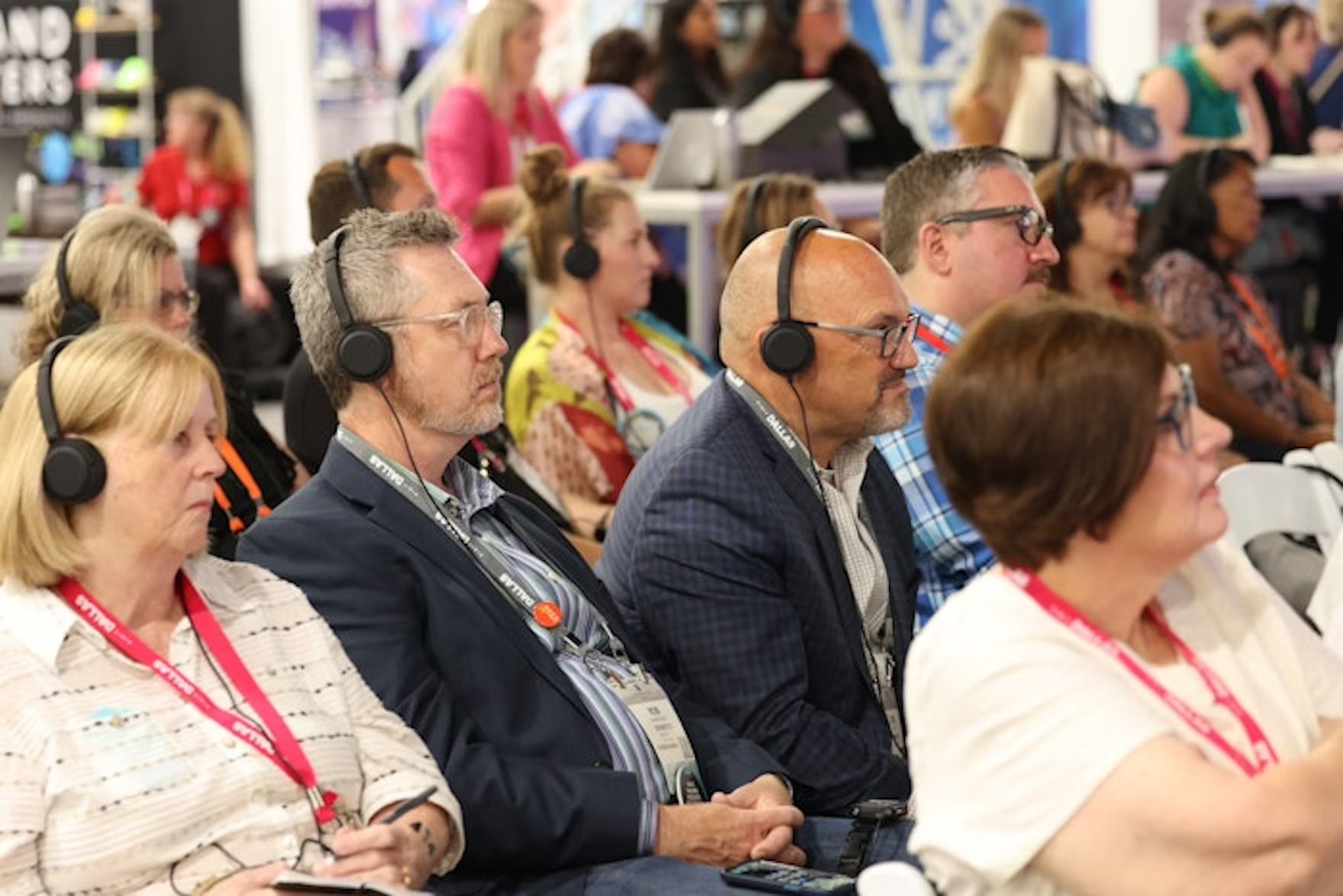
Implecho Headsets Elevate Speaker Showcase Experience at Connect Marketplace
As the official headset sponsor for Connect Marketplace, recently held at the ......
.webp?width=6960&height=4640&name=IMG_6596%20(1).webp)
Headset Communication Systems for Large Events vs. Plant Tours
What's the Difference? A plant tour and a conference session at a large event ......
Trade Show Communication: 3 Trends Shaping Better Event Execution
Trade shows are built for teams who plan with purpose and execute with ......
