Event planners and festival teams agree that digital two-way radio rentals are critical communication tools at large events. But to fully leverage these devices, two-way radios need to be viewed as more than just equipment that’s assigned to various users.
Tim Van Hiel, VP of Technical Strategy & Integration for Comm Direct Rental, a division of Implecho, explains that the real value isn’t the device itself. Rather, it’s how communication is designed, structured, and controlled across the entire event footprint to ensure it works when you need it.
What Types of Events Require Two-way Radio Rental?
When designing a communication system, we first need to explore where the event is located. Is it in the countryside or a wooded area? Is it at an arena? Is it in a city in between tall buildings? How many stages and job trailers?
Different environments demand different communication plans, and your needs will vary widely based on your type of event. For this article, we’re focusing on the following:
-
Multi-day outdoor festivals: Hundreds of talk groups, wide-area coverage, centralized command
-
Corporate conferences: Multiple buildings and hotels, linked systems, heavy coordination of security and logistics
-
Stadium and sporting events: High-density environments with concrete and steel, requiring strong in-building coverage
-
Trade shows: Large exhibit halls with constant movement, many vendors, rooms, and layered teams
If you’re tasked with planning a large event like those mentioned above, the following considerations must be taken into account when it comes to designing your two-way radio communication system for events.
The Real Communication Challenge at Large Events
Most breakdowns happen not because teams lack equipment but because they lack a plan. That plan needs to go beyond simply providing a radio to everyone who needs one. They need to know how to use it and when or how to reach necessary event staff easily.
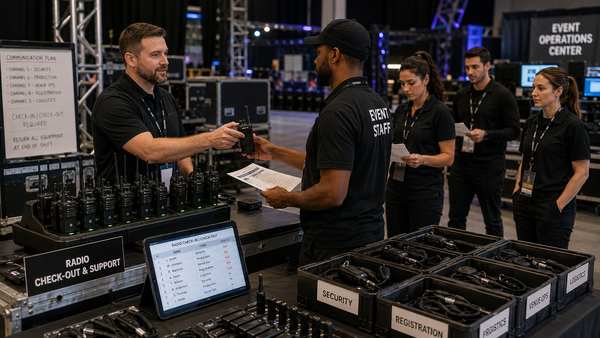
For an event to run smoothly, users need instant access and private conversations with the following teams, especially when escalation is needed.
- Security
- Medical
- Production
- Stage crews
- Vendors
- Transportation
- Ticket teams
Coordinating multiple groups is fundamentally different from supporting a single team. Without structure, channels become noisy, interference increases and response times suffer. That’s why we recommend zones and talk groups.
How Zones and Talk Groups Keep Teams Aligned (Without Talking Over Each Other)
At a large event, teams need to talk freely within their own group while still being able to reach others outside their channel quickly and easily without fumbling with knobs or experiencing interference. For example, a security team member or stage crew personnel may need to contact someone from the medical team to address an urgent need. Two-way radio zones and talk groups make this possible.
What are zones and talk groups?
- Zones are role-based groupings (security, medical, stage, operations)
- Talk groups define who can talk to whom within and across those roles
Each team gets dedicated internal channels for day-to-day operations, and shared “bridge” channels for command, medical or security escalation. This allows individuals to reach another team instantly without leaving their zone or hunting for channels.
A radio rental provider who specializes in large events can help you develop a communication plan that addresses these needs, resulting in faster coordination, less confusion and zero guesswork on show day.
“At a major event, there are far more talk groups than people realize: back-of-house, transportation, wide-area teams. We’ve supported events with hundreds of talk groups. Our job is to help build that plan, then refine it by seeing what actually gets used and simplifying where we can.” - Tim Van Hiel, VP of Technical Strategy & Integration
Designing a Communication Plan for Event Environments
Effective event radio communication starts long before counting the number of radios. A strategic planning process considers:
-
Event footprint and geography
-
Urban vs. rural location
-
Buildings, trailers, stages, containers
-
Crowd density and movement patterns
Coverage planning should come first rather than trying to figure out the number of radios you need. For best coverage, Tim typically recommends radios that use a UHF frequency band. Repeaters can be strategically positioned as part of the infrastructure, helping to extend coverage across expansive footprints.
Why use UHF two-way radios for events?
UHF technology is the most practical and reliable foundation for today’s large-scale event communication. It is still the standard for large event communication because it performs better in dense, real-world environments.
-
UHF signals are more effective at penetrating concrete, steel, trailers and temporary structures, which are common at festivals, stadiums, convention centers and urban event sites
-
Modern digital two-way radio systems run on UHF and support advanced features like trunking, encryption, GPS, emergency alerts, and centralized monitoring
Part of developing a plan is learning from past failures. If your coverage didn’t meet expectations last year, a qualified provider will dig deep to identify where signals dropped, which areas were underpowered and how the environment actually behaved under real-world conditions.
Why Trunked Radio Systems Matter at Scale
A trunked radio system is a centrally managed radio network that dynamically assigns shared frequencies to different talk groups as needed, allowing many teams to communicate simultaneously without interference or channel congestion.
Without trunking, radio-to-radio (simplex) communication can break down when:
- Channel counts exceed ~15–20
- Too many frequencies are active at once
- Interference and noise overwhelm the site
Trunked radio systems help keep airways cleaner and eliminate these issues by:
- Using fewer shared frequencies
- Assigning channels dynamically, only when someone speaks
- Preventing teams from talking over each other
In practice, hundreds of conversations can happen simultaneously without interference. This is why well-run festivals and corporate events often appear effortless on the surface.
Redundancy Is Not Optional at High-Stakes Events
Implecho insists on system redundancy to serve as a backup. In addition to onsite coordination, systems are intentionally overbuilt and designed to handle:
- Interference from external vendors
- Equipment or repeater failure
- Unexpected spikes in channel demand
Tim notes that systems are designed to exceed required capacity, ensuring that if a channel drops or a repeater goes down, it will automatically take itself out of service so the rest of the system continues to run uninterrupted.
An issue at many larger events is interference from external systems brought in by vendors or production crews. For example, vendors might have personal two-way radio devices, and production crews often use wireless microphones or headsets. Interference can occur when these external devices land on a channel or frequency already in use.
That’s why Implecho provides onsite support and frequency coordination services at events. We work with anyone who wants to bring in third-party devices to document their equipment and which frequencies they use to mitigate interference issues.
Programming Radios So Teams Don’t Have to Think on Show Day
Implecho offers Motorola Solutions two-way radio rentals because they offer the widest range of features and reliability. While some of the inner-workings noted here may seem complex, providing a simple user experience is at the heart of all we do.
Implecho custom-programs Motorola Solutions two-way radio rentals with:
- Clear, role-based channel names
- Intuitive zone layouts
- Minimal training requirements
Radios arrive tested, labeled and ready to work. “Sometimes, we’ll even send somebody out to the site to scan all the channels to ensure they’re clear and they work,” said Tim. He emphasizes that pre-programming and testing matter far more than the list of features. When users don’t have to think about their radios, they can focus on the event.
Alignment Comes From Design, Not Devices
Keeping teams aligned, reducing interference and supporting safety-critical operations are how top event planners around the country keep their operations running smoothly. It requires more than simply renting the right equipment and accessories. Having a strategic communications plan developed by an experienced team will help ensure your event goes off without a hitch.
Let’s design a radio system that fits how your event teams actually work. Explore Two-Way Radio Rentals for large events, and talk with our team of experts to design a plan for you.