When large events run smoothly, most attendees never think about communication at all.
They simply hear what they’re supposed to hear, move where they’re supposed to go, and experience the event the way it was intended.
Behind the scenes, however, planners know the truth: audio communication is one of the most complex parts of any live event. When it’s overlooked or oversimplified, small issues escalate quickly, missed cues, confused teams, frustrated guests, and unnecessary stress on show day.
That’s why effective event audio communication planning isn’t about picking gear at the last minute. It’s about understanding how people need to hear and how teams need to coordinate — and designing systems that hold up once noise, movement, and pressure are introduced.
This guide breaks down what planners should consider when designing event audio communications, drawing from real-world deployments across conferences, trade shows, festivals, and VIP tours.
Want the full planning checklist?
👉 Download the Event Audio Communications Planning Guide
Why Event Audio Communication Planning Matters More Than Equipment
Most event communication problems stem from planning gaps.
They start with assumptions.
- Assuming the room will stay quiet
- Assuming staff will “figure it out”
- Assuming one solution works for every use case
- Assuming communication only matters during presentations
In reality, events involve multiple communication layers happening at once:
- Guests listening to presenters or guides
- Staff coordinating logistics in real time
- Security and medical teams needing priority access
- AV, production, and venue teams sharing updates
Without a plan that accounts for these layers, even high-quality equipment can struggle once the event goes live.
Event Communication Headsets: When Listening Experience Comes First
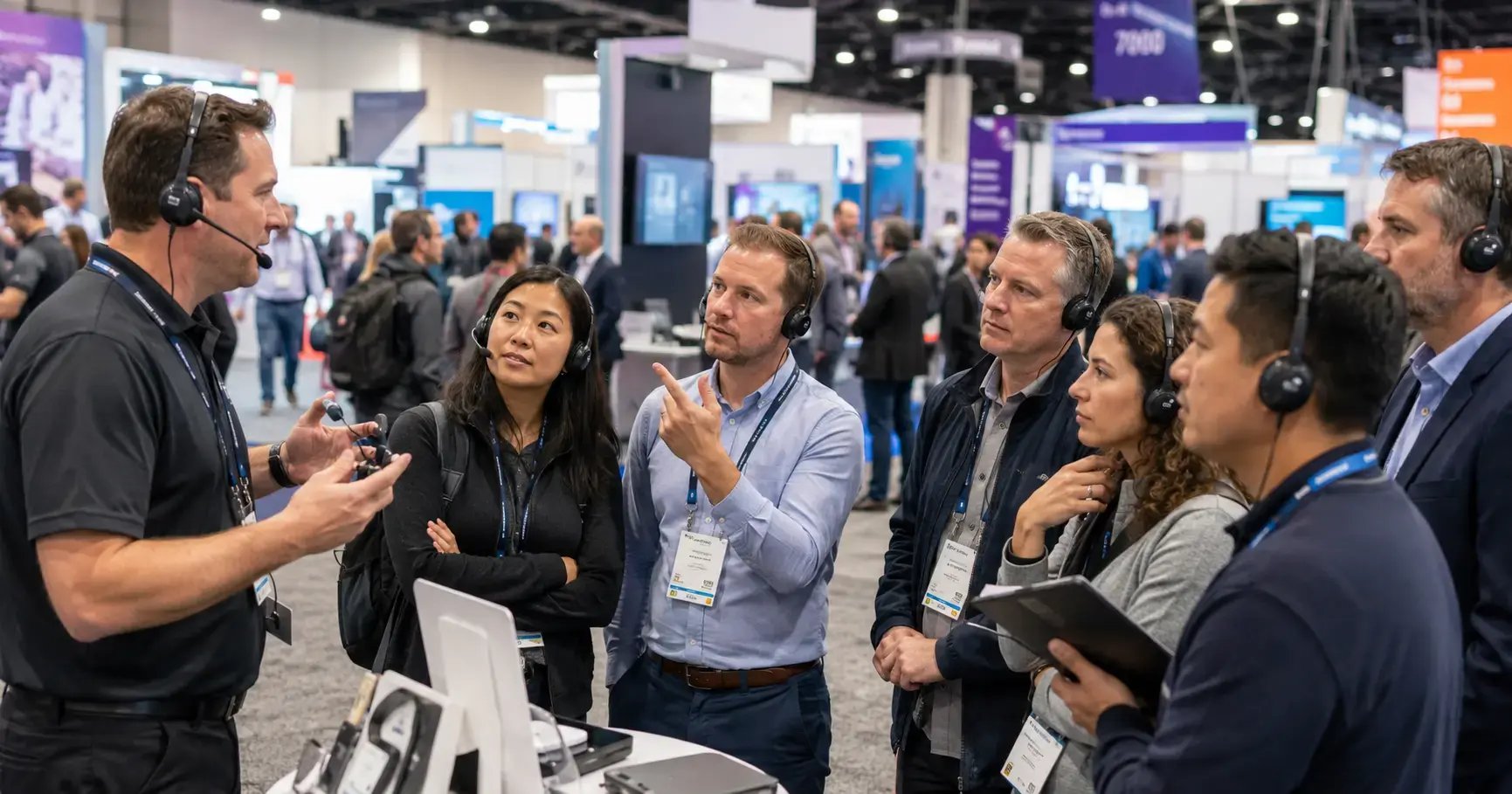
Event communication headsets are designed for environments where clarity and experience matter most.
They’re commonly used for:
- Trade show and expo tours
- Silent sessions and innovation theaters
- VIP facility tours and open houses
- Assistive listening and language interpretation
In noisy environments like convention halls or outdoor festivals, trying to project sound into the air often creates more chaos than clarity. Headset-based systems solve this by delivering audio directly to the listener.
What to Look for in Event Communication Headsets
When planning headset-based audio, consider:
- Noise-canceling capabilities to cut through ambient sound
- One-way vs. two-way communication, depending on interaction needs
- Multi-channel support for concurrent sessions or tours
- Professional appearance and comfort for guests and presenters
- Scalability for growing or rotating groups
For example, multi-channel tour systems allow several presenters to run sessions simultaneously in the same space, something that’s nearly impossible with traditional loudspeaker setups.
Check out our Event Headsets page
Silent Sessions & Innovation Theaters: Making Space Where None Exists
Conferences are often limited by room availability, yet attendee demand for content keeps growing.
Silent sessions (sometimes called innovation theaters) allow multiple presentations to run side-by-side in open spaces, without competing for volume.
With wireless headsets:
- Attendees choose the session they want to hear
- Presenters don’t compete with background noise
- Event planners maximize floor space and programming
This approach is increasingly common at large conferences where flexibility and attendee choice matter as much as content quality.
VIP Tours, Language Interpretation & Assistive Listening
High-visibility tours and open houses often include:
- Executives
- Investors
- International guests
- Individuals with hearing impairments
In these environments, communication isn’t just about convenience, it’s about professionalism, accessibility, and inclusion.
Modern event audio systems can support:
- Group language interpretation
- Assistive listening compliance
- Hands-free presenter operation
- Multiple interpreter channels
- The result is a more polished, inclusive experience without adding complexity for staff.
Two-Way Radios: The Backbone of Event Coordination
While headsets focus on listening, two-way radios power coordination.
Nearly every large event relies on radios to keep operations aligned in real time — from security and medical teams to production, logistics, and venue staff.
Why Two-Way Radios Matter for Events
Two-way radios allow teams to:
- Respond immediately to issues
- Coordinate across large footprints
- Broadcast emergency messages quickly
- Maintain control even when cellular networks fail
Modern event radio systems offer:
- Multiple channels
- Role-based access
- Emergency “all call” functionality
- Accessories for loud or hands-free environments
The key isn’t just having radios, it’s designing the channel structure so critical communication isn’t buried or interrupted.
Learn more about Two-Way Radio Rentals
Accessories & Programming: Where Most Plans Break Down
Choosing the right equipment is only half the equation.
Configuring it correctly is where most events either succeed quietly or struggle publicly.
Event audio systems often require a mix of:
- Headsets, earbuds, or headphones
- Microphones (head-worn or handheld)
- Extra batteries and chargers
- Programming for channels, presenters, and groups
Pre-programming systems based on how the event will actually run dramatically reduces training time and on-site confusion, especially when volunteers, contractors, or rotating staff are involved.
Do You Need On-Site Technical Support?
Some events can run smoothly with pre-configured, self-serve systems.
Others benefit significantly from on-site audio communication support.
On-site technicians can assist with:
- Receiving and setup
- System programming
- Working alongside AV teams
- Distributing and managing equipment
- Live troubleshooting during the event
- Sanitizing, tracking, and packing equipment
On-site support is strongly recommended for:
- High-stakes or high-visibility events
- Complex programs with multiple presenters
- Large-scale deployments
- Short-staffed planning teams
Event Audio Communication Is About Confidence, Not Complexity
When audio communication is planned correctly:
- Guests feel engaged and informed
- Staff stays calm and coordinated
- Issues are resolved before they escalate
- Event teams can focus on the experience, not the equipment
That’s the real goal of event audio communication planning.
Want the complete planning framework?
👉 Download the Event Audio Communications Planning Guide


.jpg?width=4000&height=3000&name=20251118_050958%20(1).jpg)