How Security and Safety Features in Event Radio Rental Systems Protect Your Event
The safest events are not the ones where nothing goes wrong. They are the ones where teams are already connected when something does.
Security, medical, operations, production and leadership each carry a piece of the event's safety picture. When those teams share a structured two-way radio communication system, incidents are contained faster, decisions get made with better information and attendees rarely notice anything happened.
The right event radio rental system paired with the right service partner supports that kind of coordination. But even the best two-way radio features only benefit event teams when a plan is already in place. This article highlights the importance of both.
Explore Two-Way Radios for Events
Event Safety Starts With Communication Planning, Not Equipment
Safety Is a Shared Responsibility Across the Full Event Team
No single team owns event safety. Everyone plays a role in monitoring their surroundings and supporting safety initiatives for their teams:
- Security handles access and crowd management
- Medical responds to health emergencies
- Operations oversees logistics, potential risks and safety planning
- Production supports emergency response and stage crew safety
- Leadership monitors the full picture and makes major decisions
Each of those teams needs to communicate within their own group and across groups when situations escalate. If the communication structure is not designed around that reality, even the best equipment will not close the gap.
Systems Built Before Incidents Happen Support Safety
Events that handle incidents well do not improvise. They build a communication system ahead of time that connects every critical function, assigns clear channels and defines how information flows when the pace accelerates.
Technology supports the plan. It does not replace it.
Communication Challenges That Show Up at Every Large Event
Common Incidents That Require Fast Coordination
Large-scale events create situations where seconds matter and every team needs to be on the same page immediately. The most common scenarios that strain communication systems include:
- Medical emergencies in crowded or hard-to-access areas
- Severe weather requiring shelter-in-place or evacuation decisions
- Crowd management issues at entry points, main stages or high-density zones
- Unauthorized access or security perimeter breaches
- Operational disruptions affecting show timing, power or vendor coordination
- Lost persons, especially involving children or guests who need medical attention
None of these are surprises. Events of any size should plan for all of them.
What Breaks Down When Communication Is Not Structured?
When teams arrive at a large event without a clear communication framework, the signs can show up quickly:
- Too many teams end up on one channel
- Communication traffic is congested
- Security struggles to reach medical and escalate critical issues
- Teams get busy signals or struggle to hear clearly
- Critical calls get buried
The result is slower response times, unclear escalation paths and teams operating in silos at the exact moment they need to work together. What looks like an equipment problem is almost always a planning problem.
Why Communication Planning Improves Incident Response and Safety
Incident Response Depends on Role Clarity and Escalation Procedures
No one should make decisions on the fly when an incident occurs. Everyone needs to know their role immediately. Teams should be able to quickly answer the following questions:
- Who identifies the situation or safety incident and calls it in?
- Who dispatches the response team and how can they be reached?
- Who escalates to leadership?
- Who keeps operations informed without creating unnecessary channel traffic?
Defining those answers before the event begins is what makes fast, calm coordination possible. A structured communication plan assigns responsibilities clearly.
Situational Awareness and Safety Improve When Updates Are Structured
Getting the right information to the right people at the right time is the core function of event communication. That means leadership receives incident updates without having to monitor every channel. Medical gets dispatched without security traffic bleeding into their channel. The operations team stays informed on a need-to-know basis.
Fast, calm coordination does more than protect staff and attendees. It protects the event itself. When teams are connected and escalation is clear, most incidents resolve before they ripple into the attendee experience.
Intentionally designed communication plans and structured channel assignments make seamless communication and quick incident response possible, whereas unstructured channel plans guarantee noise, confusion and delayed responses.
Two-Way Radio Features That Support Safer Events With Proper Planning
Radio safety features are still important and are most effective when they reinforce a structured communication matrix that defines each channel’s function.
Each team should operate on its own channel with clear paths for cross-team escalation. This keeps traffic purposeful, reduces noise and ensures that the right people can always reach each other without interference from unrelated activity.
A purposeful communication matrix with clearly defined channel assignments is the foundation, and each of the following features builds on it:
Priority Channels and All Call Functionality
When radio traffic spikes during an incident, standard channels can become congested fast.
Priority channels allow designated users, typically security supervisors, medical leads or incident commanders, to push communications through even when the network is under load. Critical calls do not get buried. Response moves faster.
All call is a feature programmed into radios that takes that one step further. It broadcasts a single message instantly across every radio in the system, reaching all teams simultaneously with the same directive and keeping everyone on the same page.
For event teams, priority channels and all call features work together:
- Priority channels keep critical intra-team traffic moving cleanly during an incident
- All calls allow leadership to reach the entire operation at once during emergencies, including severe weather, venue evacuation or a large-scale access situation
Tip: Coordinate With Local First Responders
Some incidents may require assistance beyond your team’s capacity. Your communication plan should define in advance how to reach local law enforcement, fire and EMS, which typically operate on dedicated licensed frequencies separate from event radio systems. Establish a liaison channel, contact protocol and clear handoff procedure for incidents.
GPS Tracking Features
Knowing where your resources are is just as important as being able to reach them. StreetTrek Solutions is a dedicated GPS tracking platform that integrates directly into our two-way radio rental systems, providing real-time location data for every tagged team member across the venue footprint.
How does two-way radio GPS tracking work?
When an incident is reported, the team managing dispatch can see exactly where the nearest security or medical personnel are located and deploy accordingly. There is no guessing, no calling around to find who is closest and no delay while someone relocates from a position that is already covered. You dispatch the closest available resource and the response moves quickly.
GPS features can also be integrated with video surveillance systems and emergency management command centers, which means dispatch decisions are supported by both location data and live visual context. At a large festival or multi-stage outdoor event, the combination gives incident command a significantly clearer operational picture than radio communication alone can provide.
For emergency services integration, StreetTrek's fleet visibility can support coordination with local EMS and law enforcement by helping your event team communicate precise, real-time location information to responding units rather than directing them to a general area. A specific GPS location reduces response time and removes a common source of confusion when public safety personnel are unfamiliar with the venue layout.
Emergency Button
The emergency button is one of the most operationally important features on the radio. It gives designated personnel a silent, instant way to signal that backup is needed now, without announcing that call to anyone nearby.
Security personnel working access points, crowd management positions or perimeter patrol often encounter situations that escalate quickly, including physical confrontation, unauthorized access or a medical emergency. A single press of an emergency button sends an immediate, prioritized alert to incident command and every designated responder in the system. It does not require a verbal call, a free hand or a clear channel.
The emergency button also creates a documented alert in the system. That record supports post-event review, incident reporting and accountability across the operation. For events that work closely with local law enforcement or private security firms, that documentation is often part of a broader incident management protocol.
Tip: Establish Two-Way Radio Emergency Button Protocol
When configuring the emergency button, define in advance who receives the alert, what the expected response protocol is and how quickly acknowledgment should occur. A button that sends an alert that no one monitors defeats the purpose.
Voice of God Integration
Voice of God systems allow event operations to deliver amplified, venue-wide public announcements. When integrated with the radio communication system, the team managing public messaging stays coordinated with the teams managing the incident response.
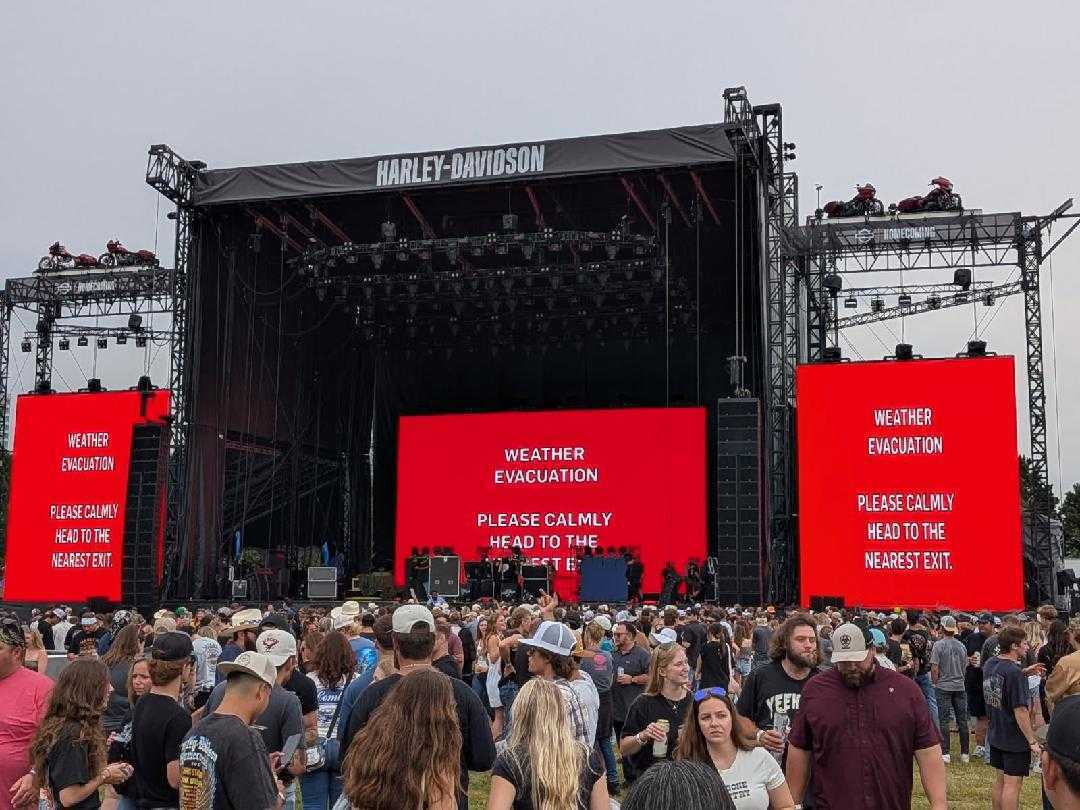
The feature allows the event command center to override a stage’s public address system. This is used only in case of emergency to directly address attendees in real time during emergencies or imminent danger. For example, if a severe thunderstorm approaches an outdoor music festival, the Voice of God system would ensure leadership has the ability to override production, stop the entertainment and deliver evacuation orders.
It’s important to coordinate such an announcement with security and medical teams so they are in position to manage the incident. A coordinated message delivered at the right moment keeps attendees calm and supports the response already underway.
Go Deeper: What Are Voice of God Systems for Two-Way Radios?
Video System Integration
Integrating radio communication with video surveillance is an added feature that can be programmed in coordination with your video surveillance supplier, giving incident command a richer picture of what is happening in real time. Teams can confirm reports visually, direct resources more precisely and make faster decisions with better information.
For events with large crowds, multiple stages or complex venue layouts, video integration adds a layer of situational awareness that radio communication alone cannot provide.
Communication Challenge and Supporting Feature
| Challenge | Feature |
|---|---|
| Rapid incident communication across all teams | All Call |
| Keeping critical calls clear when traffic spikes | Priority Channels |
| Locating and dispatching the nearest available resource | GPS Tracking |
| Emergency escalation without a verbal call | Emergency Button |
| Broadcasting venue-wide instructions during an incident | Voice of God |
| Real-time situational awareness and resource direction | Video System Integration |
Real-World Scenario: Medical Incident in a Crowded Festival Area
What Happened and Why Seconds Matter
A medical emergency occurred near the main stage during peak attendance, and response teams face several challenges:
-
- The area was dense
- The patient needed immediate attention
- Security needed to manage crowd flow around the scene
- Operations needed to know without disrupting their current workflows
- Leadership needed to be updated
How the Communication System Supports Response
In such a situation, a well-designed radio system and communication plan helps ensure:
-
- Security identifies the incident and calls it in on their dedicated channel
- The medical channel is activated and GPS identifies the nearest available medical team by location
- Medical moves toward the scene while security begins managing the crowd perimeter
- Leadership receives an update through their dedicated command channel without monitoring the full security or medical traffic
- Operations is notified on their channel with the information they need to stay ahead of any logistical impact
- The communication matrix keeps each of those conversations in the right lane
- Channel congestion does not slow any team down
Outcome
Proper planning and execution means:
-
- The response reached the patient faster
- Crowd flow was managed before a secondary issue developed
- Leadership had accurate information to make decisions
- Attendees in the area felt confident that a situation was handled appropriately with a professional response
- The event continued without disruption
Better outcomes are not the result of better equipment alone. They are the result of a system designed to communicate across teams before the incident happens.
The Comm Direct Rental Difference: Features Support the Plan, Not the Other Way Around
Why Feature-First Thinking Is Incomplete
Most articles about event radio security focus on features and technical specs. That is useful, but it is not the same as operational readiness. A radio with an emergency button does not improve response time if the person pressing it does not know who receives the alert, what happens next, or when help might arrive.
Features are only as effective as the plan they support.
Comm Direct Rental’s Advantage in Safety-Driven Communication Design
The team at Comm Direct Rental, a Division of Implecho, brings direct experience supporting large-scale live events across music festivals, corporate events, sporting events and large public gatherings.
We do not start with equipment. We start with questions:
-
- Who needs to communicate?
- What are the critical channels needed for security and emergency management?
- What does leadership need to know and when?
- What happens when traffic spikes during an incident?
- How will teams coordinate with first responders?
From there, we help build a communication matrix, select the features that support it and ensure the system is tested, distributed and ready before the event goes live.
Key Takeaways
-
- Event safety depends on cross-functional coordination across security, medical, operations, production and leadership.
- Communication planning comes first. Features support the plan.
- A structured communication matrix keeps traffic purposeful and escalation clear.
- Priority channels keep critical team traffic moving during incidents.
- All call reaches the full operation simultaneously when everyone needs the same directive.
- For emergency services integration, define handoff protocols, liaison channels and public safety frequency separation in advance.
- GPS tracking integrates with your radio system to dispatch the closest available resource in real time.
- The emergency button gives safety and security teams a silent, instant escalation path when a verbal call is not possible.
- Voice of God integration aligns public messaging with the operational response already underway.
- Video system integration improves situational awareness and decision-making in real time.
- The strongest outcomes result from systems designed before the event, not improvised during it.
Ready to Build Your Event's Communication Plan?
Strategic communication planning combined with the right radio features and training improves response speed, reduces coordination failures and protects both attendees and staff. One without the other leaves gaps.
If your team is planning a large-scale event and evaluating radio rental systems, contact us to speak with an event communications specialist.
Frequently Asked Questions
What radio features are most important for event security and safety?
The most impactful features depend on the event's communication plan. Generally, a well-structured channel matrix, priority channels, all call functionality and GPS tracking provide the strongest foundation for fast, coordinated incident response.
How does a communication matrix improve event safety?
A communication matrix assigns dedicated channels to each functional team, including security, medical, operations, production and leadership, with clear escalation paths between them. It reduces channel congestion, speeds up response and ensures the right information reaches the right people without unnecessary noise.
What is all call functionality on a two-way radio?
All call broadcasts a single message to every radio in the system simultaneously. It is used when all teams need to receive the same directive at the same time, such as during a weather emergency or venue-wide evacuation.
How does GPS tracking help during a live event incident?
A radio system with GPS tracking gives incident command real-time location data for every tagged team member. When an incident is reported, dispatch can immediately identify the closest available security or medical resource and send them rather than calling around to determine who is nearest. StreetTrek also integrates with video surveillance systems and emergency management fleets, supporting more precise coordination with local EMS and law enforcement.
What is the emergency button on an event radio?
The emergency button sends an immediate, prioritized alert to incident command and all designated responders with a single press. For safety and security teams, it is especially important because it does not require a verbal call or a free hand to activate. Personnel in a confrontation, a medical situation or any scenario where they cannot safely speak can still signal for help instantly. It also creates a documented alert record that supports incident reporting and post-event review.
How does Voice of God integration support incident response?
Voice of God integration keeps the team managing public announcements coordinated with the teams managing the incident response. That alignment ensures public messaging supports the response in progress rather than conflicting with it.