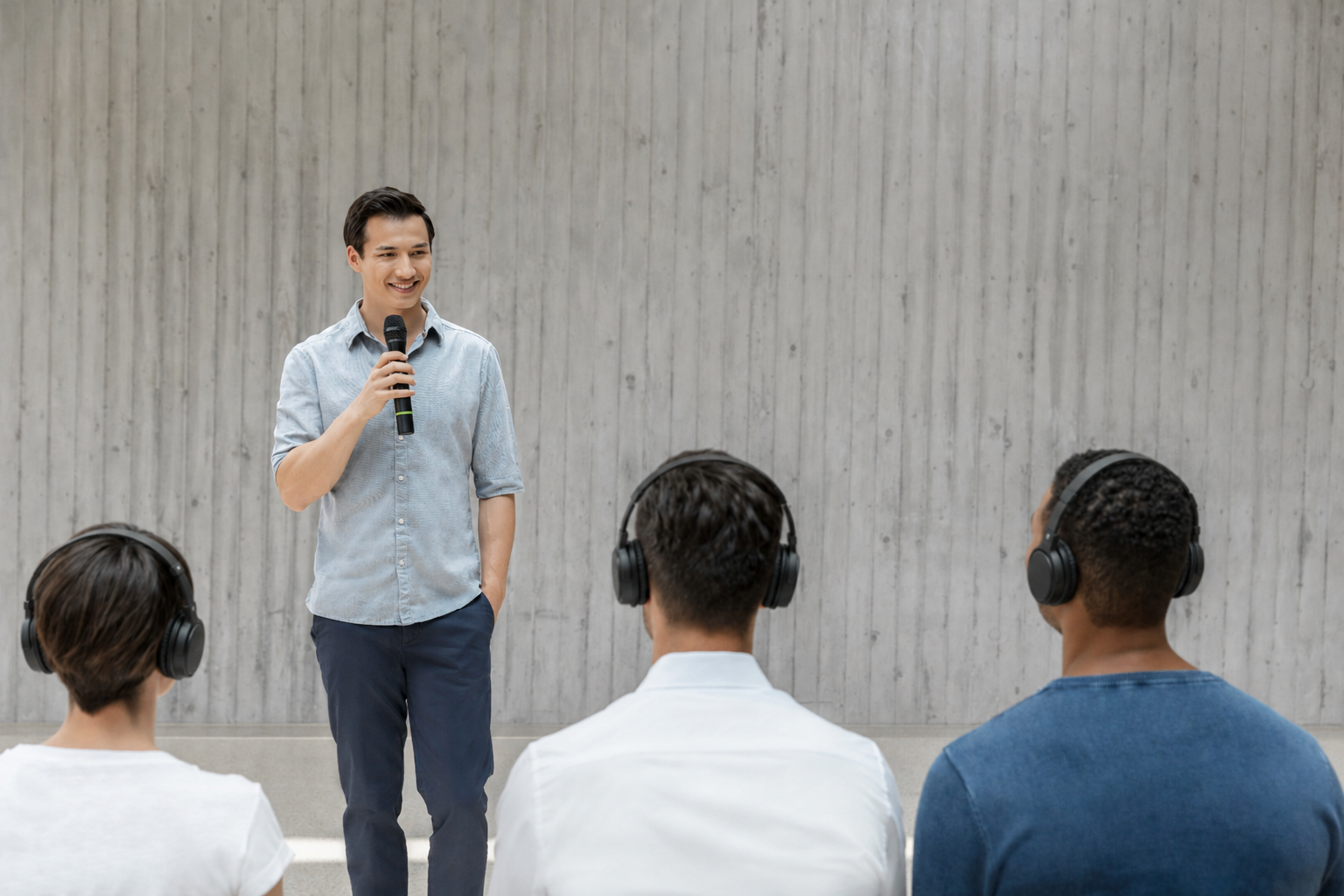
One of the first decisions planners face when scoping a tour is whether they need a one-way or two-way headset system. The answer has less to do with technology and more to do with the experience you are trying to create.
That is worth sitting with for a moment, because it changes where you should start. You are not choosing between two pieces of equipment. You are deciding how your guide and your attendees are meant to relate to each other during the tour, and the headset system simply needs to match that.
Why This Feels Like a Bigger Decision Than It Should Be
Most planners run into one-way versus two-way early in their research, often on a product page or spec sheet, and treat it like a technical fork in the road they need an engineer to help them navigate. That is understandable. Vendors tend to lead with range, channel count, and battery life before anyone asks the more basic question: what is this tour actually trying to accomplish for the people on it?
While some vendors may push features like range and battery life, they do not tell you whether your attendees need to talk to and interact with your guide or simply need to hear them clearly. Starting with specs answers a question you haven’t even asked yet.
The better starting question is this: does your tour rely on a script, or does it rely on a conversation?
Once you know the answer, the one-way versus two-way decision mostly makes itself, and that is exactly the kind of evaluation we walk planners through before we ever talk about products.
The First Question to Ask When Choosing a Headset System
Does my tour rely on a script, or does it rely on a conversation?
What Are One-Way Headsets Built For?
One-way systems are exactly what they sound like. A presenter or guide transmits one way, and the group receives their audio without the ability to respond. There is no talkback channel built in.
This setup tends to be the right fit when a tour is tightly timed, produced, and does not depend on real-time input from attendees.
Common Use Cases for One-Way Tour Headsets
- Walking tours
- Brewery or historical tours
- Plant demonstrations
- Segway or trolley tours
The guide has a script or a flow to move through, and the group’s job is to stay connected to that flow without missing anything along the way.
Why Does This Matter?
A tour built this way does not benefit from added talkback complexity. Attendees get a clear, more focused listening experience, and guides can move through their material without managing questions in real time.
What Headsets Are Recommended for One-Way Communication?
For one-way tours, we recommend the Implecho 900 or Sennheiser 2020-D. These systems can be paired with a hands-free or handheld microphone and personal receivers for each attendee. They hold up well even in noisy environments, since the goal is making sure a single voice cuts through the crowd, traffic, or ambient noise without attendees needing to crowd around the guide to hear.
What Are Two-Way Headsets Built For?
Two-way systems add a talkback channel, allowing for interactive tours. Guests and guides can both transmit and receive, and in some setups guests can also speak with each other.
This is the right fit when interaction is part of the experience itself, not an occasional interruption.
Common Use Cases for Two-Way Tour Headsets
- Q&A tours
- Training environments
- Multi-presenter setups
- Multilingual tours requiring an interpreter
It is important to note that any tour requiring live language interpretation will only work on two-way systems, so if multilingual support is even a possibility for your event, that factor alone should move you toward a two-way system.
Why Does This Matter?
A tour that depends on real dialogue, whether that is guests asking questions, multiple guides coordinating, or attendees hearing an interpreter, simply cannot function on a one-way system.
What Headsets Are Recommended for Two-Way Communication?
When planners design an interactive tour experience, systems like ListenTALK support up to 20 tour groups at once with a built-in interpretation mode, Televic Unite is built for multiple presenters with encrypted channels, and Williams AV Digi-Wave or CrewPlex tend to be a fit for rugged, high-noise, or hands-free full-duplex environments.
What Should Drive the Decision Between One-Way and Two-Way Headsets?
This is where it helps to step back from the spec sheet entirely. The right choice is not about which system has more features. It is about how your attendees will actually experience the tour, and a handful of factors tend to point the decision in one direction or the other. This is also the part of the process where an evaluation with the right partner matters, since these factors rarely point in just one direction on their own.
Level of Interaction
If your tour is built around a guide delivering information and attendees listening, one-way usually covers it. If attendees are expected to ask questions as they go, or if the experience is meant to feel like a conversation rather than a presentation, that pulls you toward two-way. Getting this wrong is usually the first thing attendees notice, either a guide fielding shouted questions on a one-way system, or a two-way system going unused because no one had anything to ask.
Tour Format
A tightly scripted, produced tour with a fixed path and timing, such as a brewery tour or historical walkthrough, tends to run cleanly on a one-way system. A more exploratory format, where guests move at different paces or engage with multiple stopping points, often benefits from the flexibility that two-way provides. The format of the tour dictates how much your guide needs to adapt in real time, and that adaptability is typically supported by a headset with talkback features.
Language Interpretation Needs
This one is closer to a hard rule rather than a judgment call. If any part of your audience needs live language interpretation, you need two-way. Period. There is no one-way path to interpretation, so this factor alone can settle the decision on its own. Discovering this requirement too late in planning is one of the more common and avoidable scrambles we see.
Related Article: Live Translation & Multilingual Tours With Wireless Headsets
Number of Presenters
A single guide leading a single group can usually work with either system, but the deciding factor is interaction, not presenter count. Multiple presenters coordinating with each other, or handing off a group mid-tour, tend to lean two-way, since that coordination often requires guides to talk to each other as much as to guests. This matters because a handoff or coordination moment that goes wrong is visible to attendees, even when they cannot say exactly why the tour suddenly felt disjointed.
Group Size and Splitting
If your event involves multiple tour groups moving through a venue at once, or if a single large group needs to split into smaller sections partway through, two-way systems tend to handle that kind of coordination more smoothly than one-way. Splitting a group without a way for guides to coordinate usually means someone falls out of sync with the rest of the tour, so generally plan on using a two-way system.
Environment
Noisy environments do not automatically point toward one system or the other. Both one-way and two-way headsets can perform well in high-noise settings like plant floors or busy exhibit halls. What actually matters in these environments is whether attendees need to respond or ask questions in real time, not the noise level itself. Planners sometimes assume a noisy environment requires a more advanced system, when in fact it usually just requires the right microphone and receiver setup for either system.
Hands-Free Requirements
If your guides need to stay hands-free throughout, whether they are operating equipment, walking backward to face a group, or managing safety considerations on a plant floor, that is worth factoring in regardless of which system you choose, since it affects microphone selection as much as the one-way or two-way decision itself.
None of these factors require you to understand transceivers or channel architecture. They are questions about your event, not about the equipment, and walking through them with someone who has seen how these decisions play out is often the difference between guessing and knowing.
Common Scenarios and Recommendations
Two-Way Headset Use Case
A manufacturing plant tour assumed a one-way system would be enough, until the planning process revealed that international guests would require language interpreters. Then, the tour operator said he needed to accommodate a hands-free Q&A time on the plant floor. Both needs meant two-way was the right call.
One-Way Headset Use Case
A VIP tour was highly produced, following a set script and requiring precise timing from one station to the next. The group hosting the tour nearly over-bought a two-way system when a one-way setup would deliver a cleaner, more cost-effective experience for such a tightly scripted walkthrough.
Common Mistakes When Choosing Between One-Way and Two-Way Headsets
In our experience, a few missteps show up often enough to call out directly:
- Assuming two-way is always the safer or more premium choice, even when the tour does not call for interaction
- Not accounting for language interpretation needs upfront, since only two-way systems support it
- Choosing one-way for a tour that turns out to need real audience interaction, then improvising a workaround mid-planning
- Overlooking noisy environments, like factory floors or outdoor sites, where NRR-rated headsets matter regardless of whether the system is one-way or two-way
Key Takeaways
- One-way systems fit clarity-focused, one-to-many tours that are produced or tightly timed
- Two-way systems fit interaction, Q&A, multi-presenter setups, and any tour needing live interpretation
- The best headset system is the one that matches your tour format, attendee experience, and communication needs
- The right partner helps you evaluate these factors, not just compare products
Not Sure Which System Fits Your Tour?
Our team of experts will help you evaluate your event, understand the tradeoffs, and recommend the solution that best fits your goals and budget, not just the one with the most features.
Contact Us
Frequently Asked Questions
What Is the Difference Between One-Way and Two-Way Headsets?
One-way systems let a presenter or guide transmit to a group with no talkback. Two-way systems allow guests and guides, and sometimes guests to each other, to both transmit and receive.
Can One-Way Systems Be Upgraded to Two-Way Later?
This depends on the specific hardware and provider. In many cases, moving from one-way to two-way means renting or purchasing different equipment rather than upgrading in place, so it is worth confirming your interaction needs before your first event rather than after.
Do I Need Two-Way Headsets for Language Interpretation?
Yes. Interpretation requires a talkback channel, which only two-way systems provide.
Which Is Better for Noisy Environments Like Plant Tours?
Both one-way and two-way systems can work in noisy environments, but the deciding factor is usually whether attendees need to ask questions or communicate hands-free, not the noise level itself. NRR-rated headsets can be used in these environments regardless of which system you choose.
How Many People Can Use a Two-Way System at Once?
It depends on the platform. Some systems, like ListenTALK, support up to 20 tour groups simultaneously, while others are built for smaller, single-group interaction. Your provider can help match group size to the right system.


.webp?width=6960&height=4640&name=IMG_6596%20(1).webp)