


Keeping Vendors Aligned on One Communication Platform at Events
Large events depend on multiple vendors working as one coordinated system. Production, security, logistics, registration, transportation and venue teams all need to share information quickly and clearly.
The challenge is that most vendors arrive with different communication tools, different workflows and different assumptions about how information should move.
That’s where breakdowns begin.
What Is a Shared Audio Communication Platform for Events?
A shared audio communication platform is a structured system. It is often powered by two-way radios, connecting vendor leads, operational teams and decision-makers through defined channels, roles and escalation paths.
Instead of fragmented communication, the platform ensures:
-
- The right people hear the right information
- Issues escalate quickly
- Teams operate with shared awareness
At scale, a communication plan is not just a technology decision. It is an operational design decision that helps create a shared structure, helping the event operate more like a coordinated whole rather than disparate teams.
"When teams align early on a shared communications plan and an organized channel matrix, vendor coordination tightens quickly and escalations stay clean and predictable." - Bridget Pedersen, President of Implecho
Why Does Vendor Communication Break Down at Large Events?
Vendor communication breaks down at large events because teams operate on separate systems, lack shared escalation paths and rely on inconsistent communication habits.
As events grow, the vendor ecosystem gets more complicated. For example, a single event may involve multiple teams:
- Internal leadership
- Venue staff
- Event production
- Food, merch and equipment vendors
- Audio and AV engineers
- Registration and ticket teams
- Transportation partners
- Security contractors
- Staffing agencies
- Third-party activations
Each group may be competent on its own, but that does not mean they are aligned.
RELATED: How Two-Way Radios Help Large Events Align Teams
The issue is not whether every vendor has a device. It is whether the right people can hear the right information at the right time. In our experience, connected teams are the clearest difference between events that feel tightly run and events that feel reactive.
"A large event deployment may have as many as 50+ vendor groups and as many as 16 to 100+ channel assignments." - Bridget Pedersen, President of Implecho
What Does Fragmented Communication Look Like During a Live Event?
Fragmented communication at events rarely looks like a total failure. It looks like slow, inconsistent coordination between teams.
What are real-world examples of fragmented communication?
- A security issue takes longer to escalate because the right people are not on the same platform
- A production update gets relayed through three people before it reaches venue operations
- A guest-flow problem is visible to one vendor but not to the teams who need to respond
- One team may rely on texts while another relies on relaying information in person, making real-time visibility impossible
This creates executive risk fast. In a live environment, slow communication is not just inconvenient. It can affect response time, guest experience, operational control and confidence across the event ecosystem.
"A large event deployment may have as many as 50+ vendor groups and as many as 16 to 100+ channel assignments." - Bridget Pedersen, President of Implecho
How Does a Shared Audio Communication Platform Improve Event Execution?
The benefits of a shared platform go beyond convenience. There are four main advantages, including:
1. Improved Escalation Speed
When the right vendor leads and operational decision-makers are connected through the same audio communication structure, issues move faster. The event does not have to rely on informal relay or delayed handoffs.
2. Improved Shared Awareness
Production can hear what venue operations needs to know. Security can escalate issues into the right structure more quickly. Registration or guest services can route problems without guessing who owns the next step.
3. Improved Accountability
When the communication structure is clear, there is less ambiguity about who monitors which channel, who owns escalation, and who needs to respond.
4. Improved Executive Confidence
Leaders do not need every person on every channel. They need to know the platform is structured well enough that important information can move quickly and predictably.
How Do You Standardize Communication Without Overloading Teams?
Standardizing an event communication system does not mean putting every vendor on the same channel or giving every user the same access.
In fact, that approach usually creates more problems than it solves.
When everyone hears everything:
- Channels become noisy
- Critical updates get buried
A well-designed audio communication platform uses role-based structure to keep communication clear and relevant.
That means:
- Vendor leads have direct cross-functional access
- Team members communicate through designated leads when appropriate
- Coordination channels connect key groups
- Dedicated channels are reserved for command, escalation or time-sensitive updates
This structure reduces unnecessary traffic while ensuring critical information moves quickly.
Why Standardization Improves More Than Coordination
Standardization also plays an important technical role, especially at large events. When vendors bring separate devices, frequencies and communication setups, the result is often:
- Overlapping signals
- Increased RF signal congestion
- Unpredictable interference
By centralizing vendors onto a shared audio communication platform, events can:
- Reduce avoidable frequency conflicts
- Maintain cleaner signal environments
- Improve system reliability under load
For larger or more complex environments, frequency coordination becomes essential to keep communication predictable and interference-free.
Standardization is not just about operational clarity. It is also what keeps the underlying communication system stable at scale.
Too many unmanaged devices in one venue doesn’t create flexibility. It often creates RF signal interference.
How Do You Decide Who Needs to Communicate at an Event?
The most effective way to design an event communication system is to map communication paths before assigning devices.
Multiple vendors naturally create communication silos unless leaders plan against them. To prevent silos, start with these questions:
- Which roles require cross-vendor communication?
- What types of updates are routine vs urgent?
- Which teams need constant visibility?
- Which teams only need escalation access?
In most events, not everyone needs direct access. The system works best when it connects:
- Vendor leads
- Command roles
- Operational coordinators
- Critical cross-functional touchpoints
Production may need direct access to venue operations. Security may need a rapid escalation path to command. Registration may need access to guest-experience or crowd-flow leads. Transportation may need a direct route into logistics or arrivals management.
When communication paths are clear, the platform becomes quieter, faster and easier to manage.
How Do You Structure a Multi-vendor Audio Communication Platform?
A good multi-vendor platform starts with role-based architecture and clear expectations for team members. Answering the following questions helps determine structure:
- Who gets direct access?
- Who communicates through a lead?
- Which channels support cross-functional coordination?
- Which are reserved for command or escalation?
- Which traffic should stay local to a specific team?
- Who is expected to listen and who is expected to respond?
- What types of issues require immediate cross-vendor communication?
The Importance of Centralized Equipment Distribution
Rather than having a box full of available devices handed out informally, audio communication equipment should be checked out and checked back in through one coordinated process.
This approach has numerous benefits:
- Teams know who has what
- Leadership has better visibility into active users
- Gear is easier to support, recover, charge, sanitize and reassign
- Vendor onboarding and user training is simplified
At larger events, centralized distribution also supports better control over what is active in the RF environment. If every vendor shows up with its own unmanaged devices, the event can end up with more overlap, more confusion and more interference risk than anyone intended. A more coordinated check-in and check-out structure helps keep the platform disciplined.
The Importance of Pre-event Testing
A multi-vendor platform should be tested with real users, realistic traffic assumptions and a clear understanding of who owns support if something goes wrong.
A few planning questions are worth asking before show day:
- Which vendors need direct access to shared audio communication channels?
- Who are the designated leads for each vendor?
- What communication paths are mission-critical?
- Which issues require immediate cross-vendor escalation?
- What terminology or response expectations need to be standardized?
- How will audio equipment be checked out, tracked, supported and checked back in?
- Has the platform been tested with real users before the event?
- Is there a backup plan if a communication path breaks down?
"At one large-scale event, our team managed hundreds of radio checkouts per day. Distribution and support were centralized through a single location, reducing the number of missing units and streamlining onboarding across vendors." - Bridget Pedersen, President of Implecho
What Are Common Hurdles to Shared Communication Adoption?
Even well-designed platforms can struggle if adoption is treated as an afterthought, leading to the following three issues:
1. Vendors May Default to Familiar Tools and Habits
Some teams resist changing devices or channel structures while others accept the platform in theory but use it inconsistently once the event gets busy. Poor audio quality, uncomfortable accessories, weak onboarding or overly complex channel architecture can make the problem worse.
2. Last-minute Changes
If access rules shift too late, if teams are not briefed clearly, or if equipment distribution is disorganized, the event starts with confusion already built in.
3. Lack of Training
We have also seen platform alignment fail because leaders assumed that providing devices was the same as creating adoption. It is not. If users do not trust the platform, don’t understand how to use it or fail to see how it fits their role, they will drift back toward fragmented behavior.
Why Should Executive Teams Care About Communication Platform Design?
Audio communication structure affects response speed, visibility, escalation discipline, and confidence during live decision-making. When leaders trust the platform, they can trust that issues will move through the event with less friction and fewer blind spots.
That matters because large events are judged by how cleanly they run under pressure.
"Guests may never see an audio communication system directly, but they absolutely experience the result of whether it works." - Bridget Pedersen, President of Implecho
A shared audio communication platform improves coordination between vendors, supports stronger operational control and creates a more unified event environment without pretending every team has the same role.
Better platform design does not just make communication tidier. It makes the event more governable.
Key Takeaways: Multi-Vendor Event Communication
- A shared audio communication platform improves coordination across vendors
- Role-based channel structure reduces noise and confusion
- Centralized equipment control improves visibility and accountability
- Clear escalation paths improve response speed
- Pre-event planning matters more than equipment selection
Final Thoughts: Why Communication Structure Determines Event Success
Events do not fail because teams lack tools. They struggle when communication is unstructured.
A well-designed audio communication platform:
- Connects the right people
- Speeds up escalation
- Improves visibility across vendors
- Supports confident decision-making in real time
The goal is not to standardize every team.
The goal is to create a system where coordination happens naturally, even under pressure.
Need help designing your communication strategy? Our team has the right combination of extensive experience and top-notch technology to bring your event to the next level. Contact us today.
Contact Us
Frequently Asked Questions
Because different vendors often arrive with different equipment, habits, priorities and levels of communication discipline. At a large event, those differences can quickly create confusion if the platform, channel structure and escalation rules are not clearly defined.
Start with a shared plan before the event begins. That usually means clear channel assignments, defined roles, escalation paths, equipment compatibility and a simple explanation of who should use what and when.
Not always, but they do need to work within the same communication structure. In some events that means shared equipment, while in others it means making sure different devices are compatible with the platform and the communication plan.
The most common issues are unclear role ownership, too many people on the wrong channels, inconsistent equipment, poor briefing and weak communication discipline. These problems usually get worse once the event becomes louder, busier and more time-sensitive.
Give them a simple communication plan, the right equipment, clear channel assignments and a short practical briefing before operations begin. If possible, test the system in real conditions so problems show up before the event is live.
You May Also Like
These Related Stories
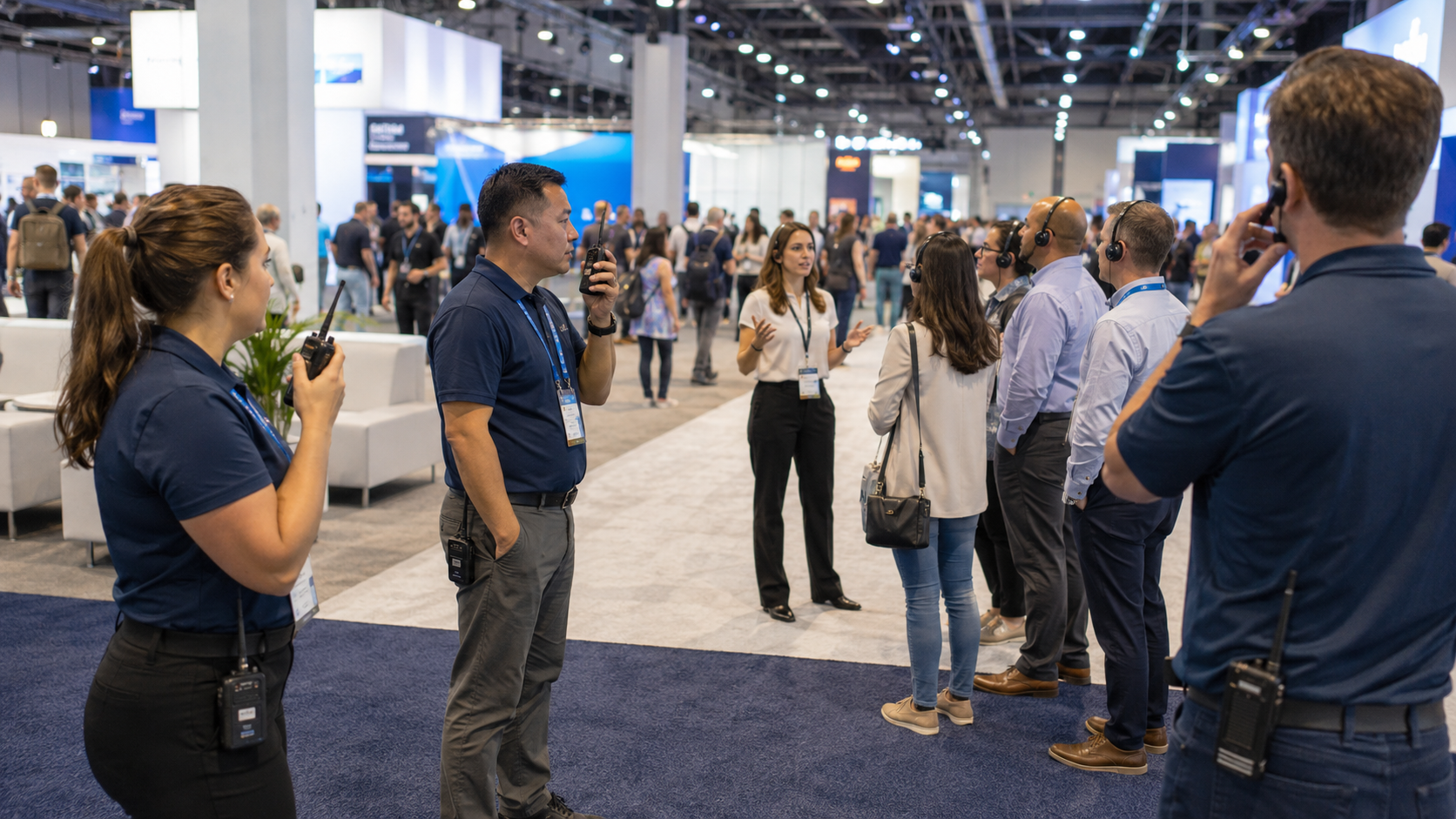
What Kind of Audio Communication Gear Do I Need for a Large-Scale Event?
When teams start planning a large-scale event, one of the most common questions ......
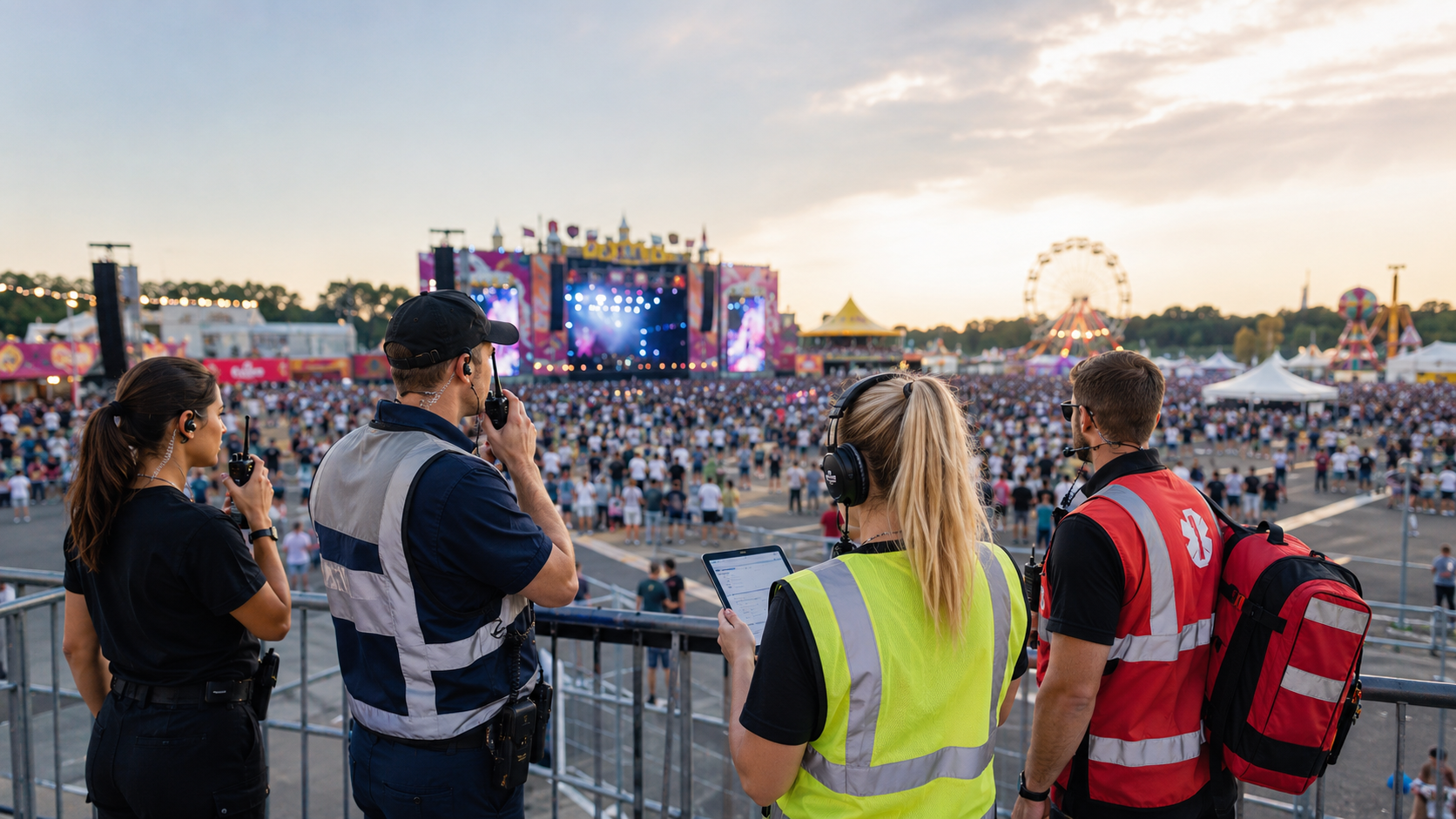
How Radio Rental Security Features Help Protect Your Event
How Security and Safety Features in Event Radio Rental Systems Protect Your ......
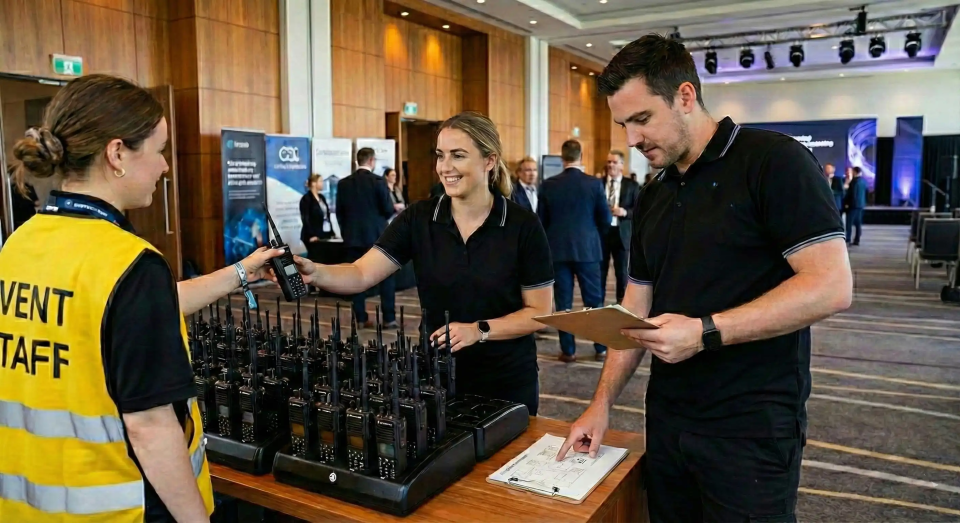
How Two-Way Radios for Large Events Align Teams (Without Chaos)
Event planners and festival teams agree that digital two-way radio rentals are ......
We're Here to Help Guide You
