


When teams start planning a large-scale event, one of the most common questions is also one of the broadest: What audio communication equipment do we need?
It sounds like a question about gear or equipment. In reality, it first needs to be a planning question.
Most large events run into trouble because their audio communication plan is too generic. Across a broad communication environment, different systems are designed to do different things. Radios are built for operations, production and security, while headsets are often designed for presenters, event attendees or training settings.
There is no single standard package for every large-scale event. The right audio communication equipment depends on how the event operates, how people move through the venue, what teams need to coordinate, what attendees need to hear, and where failure would be most disruptive.
An event held at a convention center hosted 15,000 attendees. Event organizers initially thought, “We just need radios.” Once our team evaluated workflows, logistics and programming, it became clear the event needed a more robust communication strategy, including:
- Radios for operations
- Low-profile audio accessories for staff and production
- Tour guide systems for attendee sessions and tours
- Assistive listening devices for language interpretation
Before you can determine which audio equipment belongs on the list, first ask…
What Audio Communication Challenges Does Your Event Need to Solve?
Audio communication equipment is often treated as a logistical detail. It gets pushed later in the planning process, grouped with rentals or addressed only after the broader event design is already in place.
That usually works until the event gets large enough that audio communication quality starts shaping the outcome. Once there are multiple teams, spaces, stakeholders and attendee touchpoints, audio communications stop being a background tool and start becoming part of execution itself.
When audio communications break down, the side effects show up fast:
- Timing of programming slips
- Handoffs get messy
- Teams repeat instructions
- Guest issues take longer to resolve
- Confusion escalates and staff confidence drops
Sometimes the attendees feel these pain points directly. Other times they only feel the symptom, which is a less polished event experience.
That is why equipment planning should start with a use case and expand from there. The question is not just what devices are available. It is what kind of audio communication does the event needs to support communications
"In 2025, we supported over 300 events where their initial audio communication request required changes after reviewing workflows and programming needs." - Bridget Pedersen, President of Implecho
Large-scale Events Often Require Multiple Audio Communication Solutions
There’s more to event logistics than making sure your staff is all on the same page. Organizers also need to consider attendee listening, guided movement, breakout content, noisy environments, distributed spaces and mobile teams.
One of the biggest mistakes we see is the assumption that one tool should handle everything. Large-scale events are inherently complex and almost always involve more than one type of audio communication equipment.
"No single communication device is built to support every conversation happening at a large event." - Bridget Pedersen, President of Implecho
Once you look at the event through that lens, the main equipment categories become easier to understand.
Two-way Radios
Two-way radios are often the backbone of security and staff audio communication. They help operations, logistics, security, venue teams, and production staff stay connected across spaces and time-sensitive moments. When teams need fast, reliable audio communication across multiple zones, radios are usually part of the answer.
Tour Guide Systems
Tour guide systems are designed for guided movement and mobile listening. They work well when attendees need to hear a speaker or guide while moving through a venue, facility, activity or exhibit environment. They are often a better fit than trying to stretch staff audio communication equipment into an attendee-facing use case.
Silent Session Headsets
Silent session systems are useful when content needs to be delivered in noisy spaces or shared environments without adding loudspeaker spill. They are a strong fit for expo floors, concurrent sessions, branded activations, and other event formats where attention and listening quality matter but open-air audio is not practical.
Audio and Microphone Accessories
Accessories tend to get underestimated. Microphones, spare batteries, charging systems, carry options, sanitation workflows, labeling, distribution kits and collection plans can have a major impact on how well the overall audio communication solution performs. A device may provide the connection, but the accessories often determine whether audio communication is clear, comfortable and sustainable over a long day. In noisy environments, this becomes even more important.
Large events rarely succeed with a one-device communication strategy. Different teams and attendee experiences require different communication technologies working together.
Solutions At-a-Glance
|
Communication Solution |
Best For |
Not Designed For |
|
Internal security teams, operations, logistics, emergency response |
Guided attendee listening experiences or sessions |
|
|
Breakout sessions in noisy expo halls, multilingual presentations, attendee engagement |
Production crew coordination or operational communication |
|
|
Mobile tours, plant walkthroughs, guided groups |
Internal staff coordination across departments |
This is why layered audio communication planning is so important. The right solution mix depends on roles, movement, environment and the kind of experience the event is trying to create.
How the Venue and Event Environment Impact Audio Equipment Needs
Programming and logistics aren’t the only factors that necessitate a multi-layered communication strategy. The environment itself plays a major role in determining equipment needs:- A general session held in theater-style venue has different audio communication needs than a bustling expo hall
- A guided tour requires different solutions than a multi-room silent conference
- A stadium or arena creates different coordination pressure than a ballroom program
- An outdoor festival across multiple acres may require boosted signals compared to a smaller venue
Construction materials and the layout of a venue can also impact coverage. Large footprints, service corridors, multiple floors, concrete walls and noisy public zones all shape what the equipment needs to do.
For Staff Communication
Venue complexity such as large buildings, distributed teams and back-of-house movement, often drive audio equipment decisions.
For Attendee Listening
Format matters more. Guided tours, silent sessions, interpretation support and mobile educational experiences all call for tools built around clarity, comfort and ease of use.
It’s easy to see how generic lists fall short. It is not enough to say a large event needs radios, headsets, and assisted listening systems. The more useful question is where and how each tool will be used. Strong planning respects the real event environment instead of trying to force every event into the same template.
Story from the Field
"Based on initial conversations before CES 2025, our team originally scoped using a two-way tour system for demonstrations, but once a thorough assessment of the venue and flow were conducted, we determined a one-way system with a microphone that could be passed between product leaders was a better solution." - Bridget Pedersen, President of Implecho
Different Teams Need Different Communication Tools
Another reason audio communication equipment planning gets tricky is that different groups are trying to accomplish different things.
We’ve created a table to help you identify common solutions based on the team’s role.
|
Team or Audience |
Primary Communication Need |
What Matters Most |
Best-Fit Communication Approach |
|
Operations Teams |
Dependable cross-zone coordination |
Coverage, clarity, reliability during transitions, handling issues, routine execution |
Two-way radios with accessories |
|
Production Teams |
Fast, real-time coordination |
Speed, immediate response, no delays |
Professional production headsets and/or radios |
|
Security & Logistics Teams |
Reliable communication during movement, setup, access control and incident response |
Durability, consistent coverage, hands-free usability |
Rugged two-way radios with accessories |
|
Presenters, Guides & Docents |
Delivering audio to groups/attendees |
Clear listener experience, speech intelligibility |
Tour guide systems or silent session systems |
|
Attendees |
Receiving audio comfortably and clearly |
Comfort, simplicity, audio clarity and ease-of-use |
Lightweight listener headsets or receivers |
In general, the right equipment should be determined by the task and user goals.
"Budget matters, of course. Familiarity matters too. But neither should outweigh whether the equipment actually gets the job done without being a source of friction." - Bridget Pedersen, President of Implecho
What Teams Often Underestimate When Choosing Audio Communication Equipment
An equipment list does not guarantee a good deployment. In practice, the details that make or break success are often operational. This is where many event plans start to wobble.
Coverage and venue-specific reliability matter more than teams expect, especially over long show days. So does:
- Audio clarity
- Battery life and charging disciplines
- Spare planning
- Distribution and collection
- Sanitation
- Ease of use
These factors are especially true when temporary staff or mixed-experience teams are involved. We have seen situations where the equipment itself was technically correct, but the deployment still created friction because accessories were overlooked, charging times weren’t planned out or users were handed gear that was not intuitive enough for the pace of the event.
This is also where compatibility matters. If the event uses multiple audio communication solutions, they need to work as part of one cohesive system. A strong plan accounts for how equipment is distributed, supported, managed and recovered, not just what was ordered.
A Practical Framework for Choosing the Right Equipment Mix
For most teams, the simplest way to choose well is to work through a short planning framework.
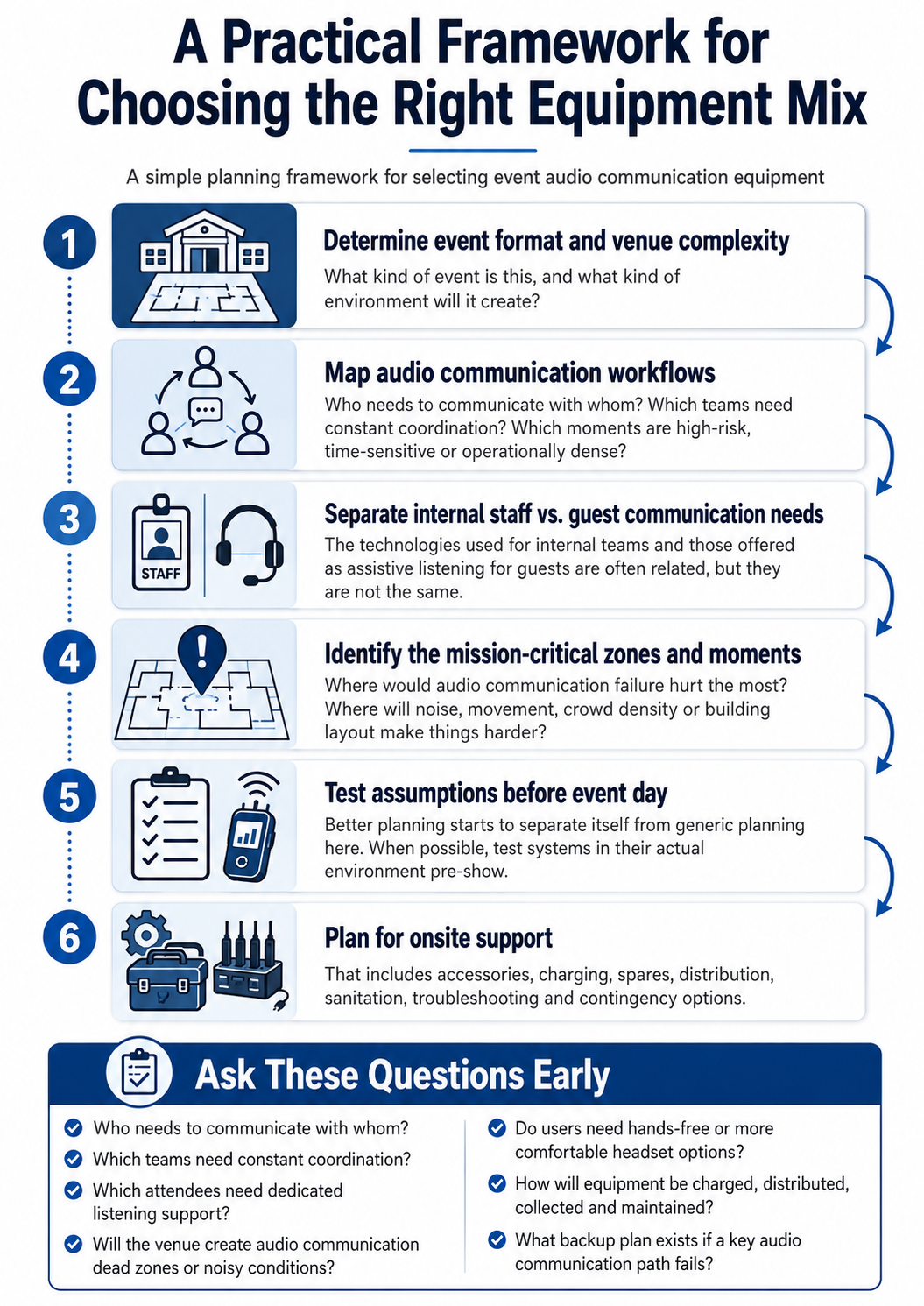
Step 1: Determine event format and venue complexity
What kind of event is this, and what kind of environment will it create?
Step 2: Map audio communication workflows
Who needs to communicate with whom? Which teams need constant coordination? Which moments are high-risk, time-sensitive or operationally dense?
Step 3: Separate internal staff vs. guest communication needs
The technologies used for internal teams and those offered as assistive listening for guests are often related, but they are not the same.
Step 4: Identify the mission-critical zones and moments
Where would audio communication failure hurt the most? Where will noise, movement, crowd density or building layout make things harder?
Step 5: Test assumptions before event day
In our experience, this is where better planning starts to separate itself from generic planning. When possible, test systems in their actual environment pre-show.
Step 6: Plan for onsite support
That includes accessories, charging, spares, distribution, sanitation, troubleshooting and contingency options.
A few planning questions are worth asking early:
- Who needs to communicate with whom?
- Which teams need constant coordination?
- Which attendees need dedicated listening support?
- Will the venue create audio communication dead zones or noisy conditions?
- Do users need hands-free or more comfortable headset options?
- How will equipment be charged, distributed, collected and maintained?
- What backup plan exists if a key audio communication path fails?
Why Large-scale Events Often Lead to Multi-solution Audio Communication Plans
Once teams think through their event scenario honestly, the answer is clear. Large-scale events often need more than one audio communication solution.
A single tool may not serve operations, production, guided experiences, attendee listening and specialized use cases equally well. That is not a sign of overcomplication. It is usually a sign that the event has real complexity.
A well-designed audio communication plan often combines radios, headsets, listening systems and the support accessories needed to make each of those tools usable in the field. The value is not in the number of devices. It is in how well they work together to support execution and experience.
This matters commercially too, but the real point is operational. Multi-solution planning reduces friction. It gives different groups the tools that fit their jobs. It helps staff communicate more confidently and helps attendees experience the event more smoothly.
Large Events Need Layered Communication Strategies
There is no universal audio communication equipment package for every large-scale event.
The strongest audio communication setups are intentional. They are role-based. They are practical. And they reflect the environment, workflows and realities of how the event will actually run.
That is the real answer to the audio equipment question. It’s not about a fixed list, but the right mix of tools for the job.
The team at Implecho has helped the show go on for some of the largest, most complex events in the nation, deploying communication rental solutions and providing onsite support. Connect with our team today to talk through your needs.
Contact Us
Subscribe
.png?width=966&height=559&name=image%20(2).png)
What Makes A Radio System Work Under Pressure
When the schedule is tight and the environment is loud, the best radio system ......
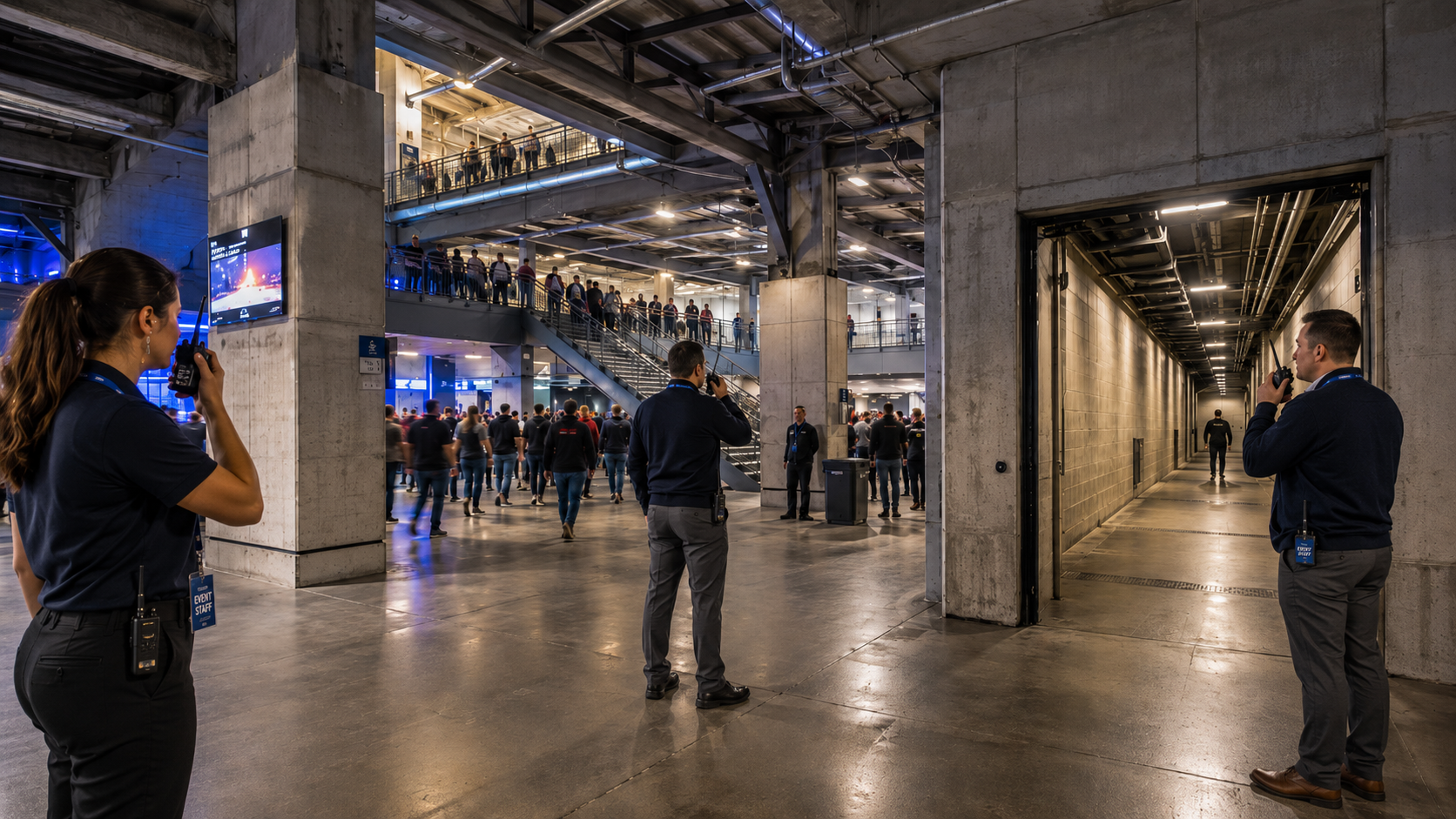
What Range Will My Two-Way Radios Get in a Convention Center or Stadium?
If you are planning communications for a convention center, stadium, arena or ......
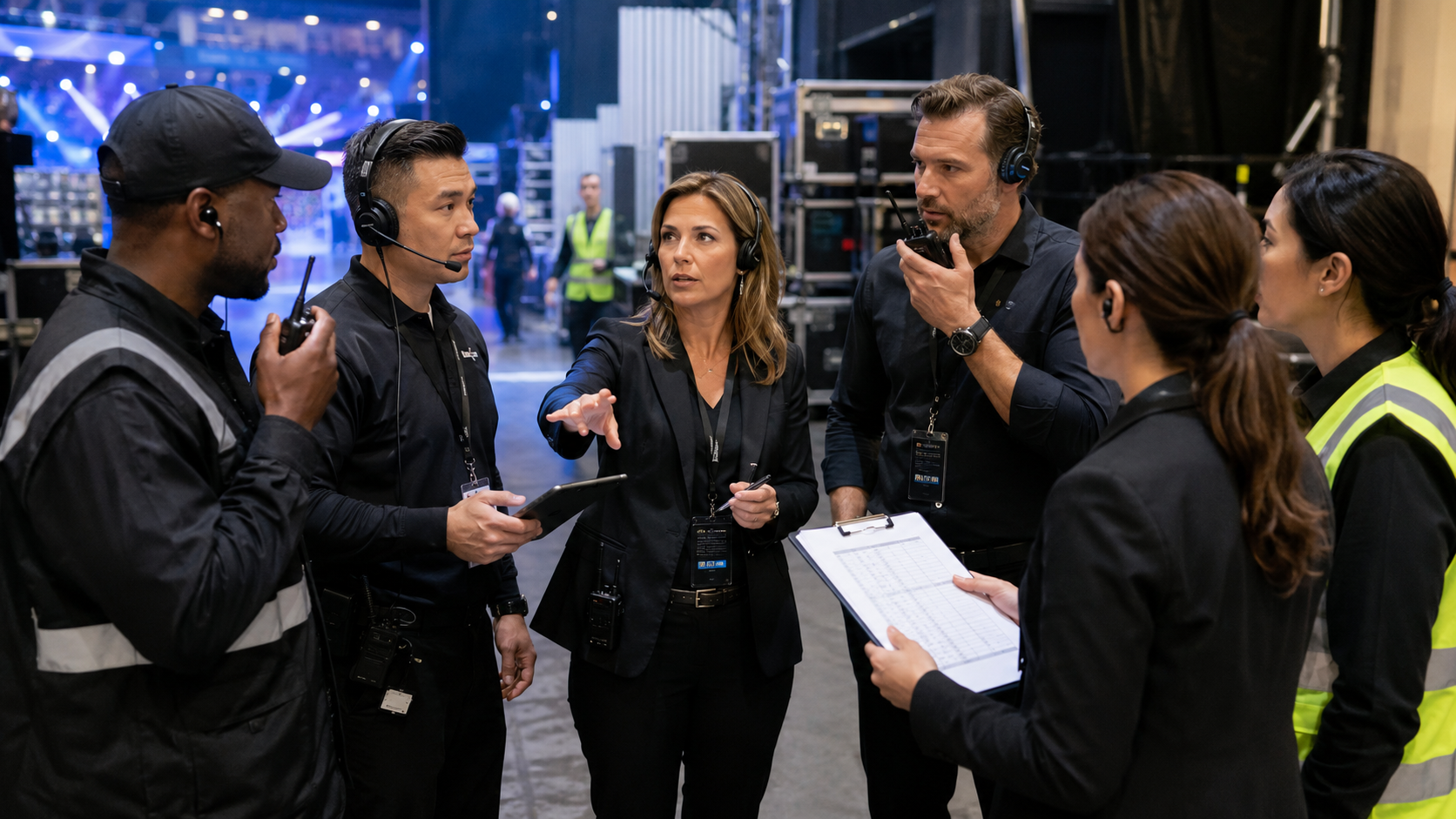
Keeping Vendors Aligned on One Communication Platform at Events
Large events depend on multiple vendors working as one coordinated system. ......
