


If you are planning communications for a convention center, stadium, arena or other large venue, one of the first questions that usually comes up is: How much range will our radios get?
It’s a straightforward question that equipment spec sheets try to answer. In practice, signal distance and range for two-way radios featured on equipment brochures are based on best-case scenarios and conditions.
In the real world, numerous factors can limit coverage and how radio signals behave, including:
- Venue construction materials (concrete, steel, glass)
- Building layout and elevation changes
- Crowd density
- Interference from other systems/electronics
Communication failures rarely happen because a radio “cannot reach far enough.” Problems usually happen because signals struggle in locations where communication matters most, like security checkpoints, concourses, or production areas.
In this article, you’ll learn the importance of a robust analysis of venue conditions, channel planning, system design and field validation to gain optimal range and coverage throughout a large venue during live events.
"During a 2025 deployment at Moscone Center and the surrounding event footprint, we tested coverage during setup, but knew conditions would change once booths, LED Walls, educational theaters, and broadcast stations, and 10s of thousands of attendees arrived. Our crew stayed onsite to test as the event ramped up and system performance was affected. These conditions were anticipated, and pre-planned solutions were implemented in real time to ensure uninterrupted communication." - John Elfring, Director of Sales for Comm Direct Rental A Division of Implecho
RELATED: How Two-Way Radios for Large Events Align Teams
Why Answers About Radio Range are Harder Than They Sound
Most who ask about radio range want a number. They want to know if the system will cover 300 feet, half a mile or the full venue. That instinct is understandable, especially when communication failures can disrupt operations, slow response times and create unnecessary stress across teams.
The problem is that convention centers and stadiums are not neutral environments. A radio that performs perfectly in an open outdoor venue or large room may behave very differently in an expansive, complex venue. Dense building materials such as concrete, steel and multi-level structures can significantly weaken RF signals indoors. In large venues, every wall, corridor and elevation change can reduce usable radio coverage compared to open line-of-sight environments.
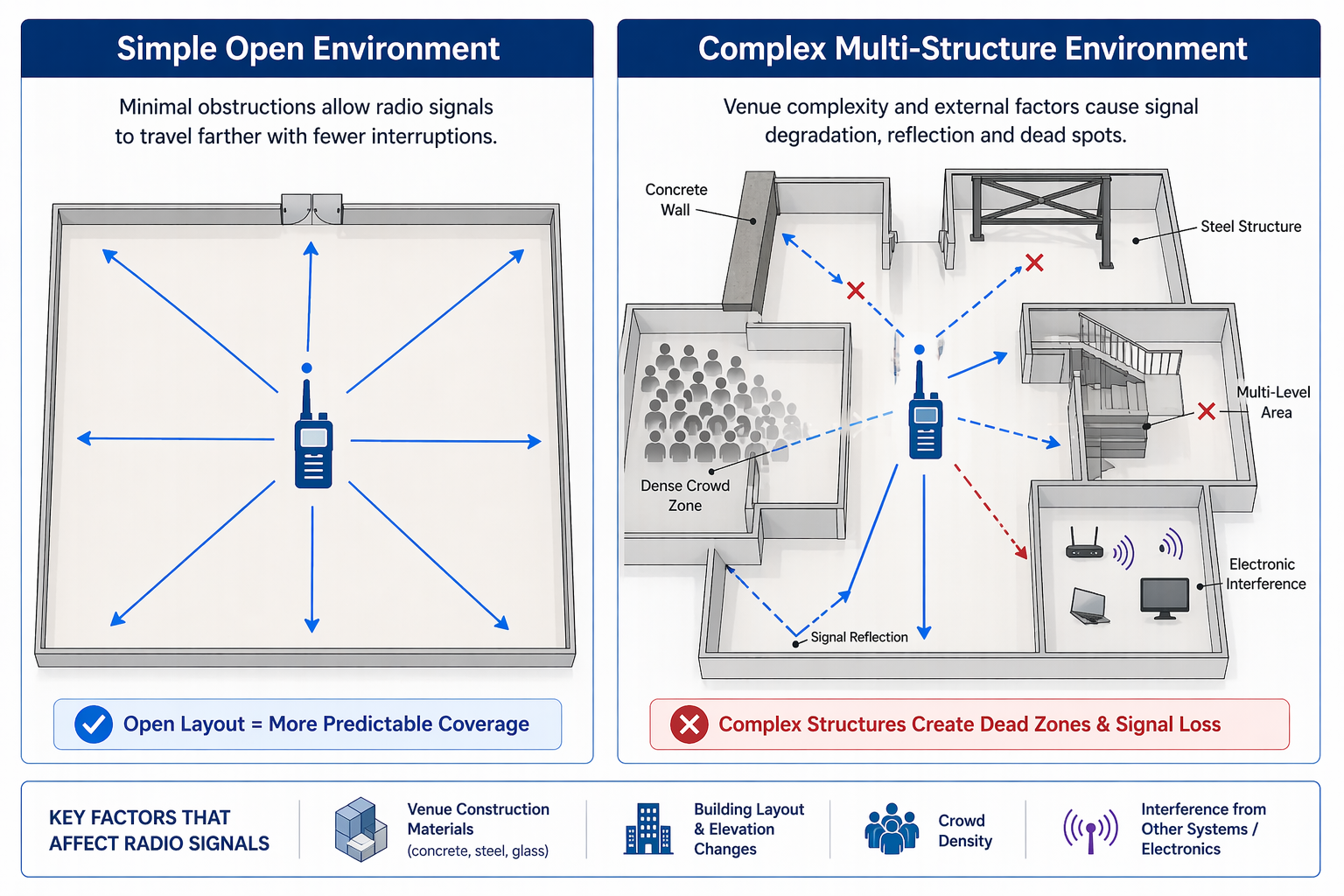
That is why “how far will it reach?” is often a question that doesn’t have a straightforward answer. A better question is this:
Will the system deliver usable, intelligible coverage across the zones where your teams actually need to work?
Why Published Radio Range Claims Can Be Misleading
Most published radio range claims are based on ideal conditions. That usually means unobstructed, line-of-sight use with minimal interference and no major structural barriers.
In other words, they don’t account for a convention center filled with steel, concrete, partitions, LED walls, back-of-house turns, multiple event spaces and thousands of moving bodies.
In a large venue, radio waves can be blocked, weakened, reflected, or distorted by dense materials and awkward building geometry. Add multiple floors, tunnels, service corridors, production equipment, and crowds, and the gap between marketed range and real-world performance gets wide fast.
If a communication plan is built mainly around an advertised range, it is already on shaky ground. Good event communication planning starts with workflows and coverage zones, not brochure numbers.
What Affects Radio Range In a Convention Center or Stadium?
If you want a realistic expectation of radio performance, there are several factors that matter much more than the headline spec.
Venue footprint and layout
A large venue is rarely one open space. It is a patchwork of:
- Exhibit halls
- Meeting rooms
- Concourses
- Loading docks
- Stairwells
- Tunnels
- Hospitality zones
- Storage areas
- Service corridors
- Security checkpoints
- Exterior edges and parking areas
Teams often move across these zones continuously. A radio system has to support that movement.
Horizontal distance matters, but vertical separation can be just as disruptive. Relatively short distances can become communication problems when teams are separated by floors, structural barriers, or back-of-house routing.
Construction materials
Concrete, steel, and dense building materials are not friendly to radio signals. Large structural elements can weaken signals or create inconsistent pockets of performance. Glass and open areas may look less obstructed, but the total environment still matters.
This is one reason stadiums and convention centers can surprise those who rent radios. The building may feel open, but the signal path is rarely simple.
Temporary event infrastructure
The impact of temporary structures often gets overlooked. The following can significantly impact radio signals:
- Trusses
- Staging
- LED walls
- Pipe and drape
- Stacked cases and speakers
- Production gear
- Temporary offices
- Job trailers
- Exhibit booths and food vendors
What looks fine during an early walkthrough may not behave the same way during show conditions.
Crowd density and show-day occupancy
The size of a crowd matters more than many radio users realize. A venue full of attendees does not behave like an empty venue during setup. Bodies absorb and obstruct signals. Noise also rises, which can make an already marginal communication path harder to use effectively.
Radio type, frequency, and system design
Equipment choice still matters. Frequency band, power level, antenna design, accessory quality, and system configuration all affect performance.
But better radios alone do not solve bad planning. In complex venues, system design usually matters more than event planners expect, and standalone radio strength matters less than they thought it would.
A venue with multiple operational zones may need more than a simple 16-channel deployment. There is no one-size fits all solution. Repeater system selection, group and zone channel planning and monitoring tools must all align with both the event organizer goals and venue conditions.
"Most communication failures in large venues are not caused by insufficient equipment, but by insufficient system design. Coverage is engineered through structure and zone planning, not just signal strength, making the difference between a system that merely powers on and one that actually supports the event." -John Elfring, Director of Sales for Comm Direct Rental A Division of Implecho
Convention Centers vs. Stadiums: How Each Creates Different Challenges
Convention centers and stadiums are both complex, but they create different communication problems.
Convention Centers
Conventions often combine open halls with segmented meeting rooms, breakout clusters, service corridors, loading areas and temporary structures. Teams may move between public-facing spaces and hidden infrastructure quickly.
Multi-hall convention center example: Teams may have clear communication in open expo areas, but lose consistency moving between meeting rooms and back-of-house corridors.
Stadiums and Arenas
Bowl seating, concourses, tunnels, restricted access points, support spaces and exterior perimeters create layered coverage challenges. Vertical separation matters more. So does the need to coordinate across security, guest services, operations and production in different parts of the building.
Stadium example: Radios may perform well in seating and concourse areas, but coverage could break down in service tunnels and perimeter access points.
In both cases, the core mistake is the same. Event planners focus too much on total distance and not enough on the actual communication map of the venue.
The Real Goal: Usable Coverage, Not Maximum Distance
Operations teams do not need a brag-worthy range. They need dependable communication in critical areas. There is a big difference.
A radio that technically connects but delivers broken, inconsistent or hard-to-understand audio is not doing the job. A system with one dead zone at the loading dock, one weak stairwell, and one unreliable tunnel can still create serious problems if those are high-traffic or high-risk areas.
The right way to judge radio performance is by operational usefulness:
- Can teams communicate clearly where they actually work?
- Can supervisors reach staff across key zones without delay?
- Does the system hold up under crowd load and noise?
- Are the high-risk areas covered, not just the easy ones?
That is also why group and zone planning matters. Not every team needs the same communication path, and forcing too many users into one structure can reduce clarity. Good system design separates workflows intelligently while preserving escalation paths.
"If communication fails in the spaces where teams move, respond, and hand off responsibility, the system is not event-ready, no matter how strong it appears on paper." - John Elfring, Director of Sales for Comm Direct Rental A Division of Implecho
Common Onsite Issues That Expose Weak Planning
Weak radio planning tends to fail in predictable places. Weak links often appear between floors or across operational zones that seemed close during planning but are functionally separate in use. The following areas typically pose greater interference than others.
Common Radio Signal Dead Zones
- Loading docks
- Stairwells
- Service corridors
- Lower-level rooms
- Tunnel transitions
- Venue perimeter
- Concrete-heavy support spaces
Another common issue is audio that technically gets through but is difficult to understand in noisy conditions. That is especially dangerous because teams may think the system is working when performance is actually degraded. They repeat messages, shorten updates, switch to workarounds or rely on runners and phones. Once that starts, operational confidence drops.
5 Planning Tips for Reliable Radio Performance in Large Venues
If you want better communication outcomes, planning has to start before the event goes live. Follow these five steps to help ensure clear communication across your venue.
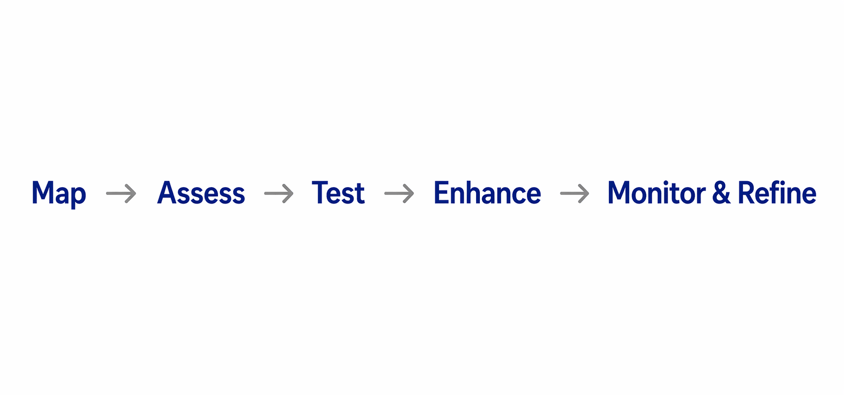
Step 1: Map who needs to talk to whom
Many teams still plan around devices instead of workflows. Operations, security, production, logistics, registration, and venue teams do not all have the same communication needs. The clearer your workflow map is, the better your system design will be.
Step 2: Identify critical coverage areas
Do not ask whether the venue is covered in a general sense. Ask whether the system performs in the places where failure would be costly. That includes ingress and egress points, backstage routes, incident zones and team handoff areas.
Step 3: Test under realistic conditions
Empty-venue tests are useful, but they are not enough. If possible, test after build elements are in place, or at minimum test known structural trouble spots with the event layout in mind.
Step 4: Think beyond radios alone
In more complex venues, repeater system selection can be critical. So can disciplined group and zone planning. A better structure often improves performance more than choosing a more powerful device.
Step 5: Use system monitoring tools where appropriate
If you run these events repeatedly, system monitoring and post-event review can improve year-over-year performance. Real deployment feedback helps refine channel design, identify weak spots and improve future planning instead of treating every event like a fresh start.
A few planning questions are worth asking before event day:
- Where do teams actually need coverage?
- Which areas are mission-critical?
- Have radios been tested inside the actual venue?
- Are there known structural or operational trouble zones?
- Will teams be working across floors, tunnels, docks, or exterior spaces?
- Is audio clarity strong enough in noisy environments?
- What is the backup plan if coverage drops in a critical area?
RELATED: What to Expect With Onsite Radio Rental Support at Large Events
When Is a More Advanced Approach to Radio Planning Necessary?
Not every venue needs a highly engineered communication architecture. But many large-scale events need more than a basic off-the-shelf radio setup.
A more deliberate communication design is usually worth it if you are dealing with a multi-level venue, mixed-use spaces, dense structural interference or other conditions noted in this article. In these cases, your radio rental system provider will likely need to go beyond a simple setup and provide the following:
- Repeaters to extend coverage
- Smart zone planning
- Dedicated escalation channels
- Tailored accessory selection
- Robust testing
- Monitoring
- Special Temporary Authority (STA) coordination with the Federal Communications Commission when required for event-specific frequency use
In an effort to simplify systems, users often end up adding risk. Communication systems should be designed to fit the venue and the event, not squeezed into a simplistic template because it feels easier.
"When the cost of failure is high, a basic setup is often the expensive choice." - John Elfring, Director of Sales for Comm Direct Rental A Division of Implecho
Reliable Communication Starts with Real-World Planning
There is no universal answer to how much range your two-way radios will get in a convention center or stadium. Real-world performance depends on:
- Structure
- Layout
- Occupancy
- Noise
- Temporary builds
- Radio type
- System design
Teams that plan for usable coverage instead of idealized distance ultimately make better decisions. Your two-way radio rental provider should have extensive experience working with large venues and anticipate potential hurdles in your communication strategy.
Implecho has decades of experience planning and deploying two-way radio systems for some of the largest venues and events in the country—from national championships to multi-campus conventions and festivals. We successfully deploy more than 250,000 radios each year. We can help solve your communication challenges, too. Contact our team today to talk through your needs.
Contact Us
Subscribe
What Kind of Audio Communication Gear Do I Need for a Large-Scale Event?
When teams start planning a large-scale event, one of the most common questions ......
.png?width=966&height=559&name=image%20(2).png)
What Makes A Radio System Work Under Pressure
When the schedule is tight and the environment is loud, the best radio system ......
Designing an Event Audio Communication Plan for High-Noise Environments
A communication plan that looks fine in a quiet planning meeting can fall apart ......
