If you manage a plant or facility, you already know the tour is never the hard part. The hard part is making sure a group of visitors can actually hear your team over the industrial equipment that runs the place.
Most planning for a loud facility starts and ends with one question: what noise-reduction rating (NRR) do we need? That question matters, but it is not the first one, and it is not the only one.
A tour through a working plant is not a single environment. It is a sequence of very different environments, some quiet, some loud enough to drown out a raised voice, all connected by a group of people who need to move safely between them.
Getting that right takes more planning than picking a headset off a spec sheet.
In this article, we identify why plant environments are so different from typical tour spaces, and provide step-by-step guidance on planning a successful plant tour.
Expert Takeaway
Designing a plant tour for a noisy environment is not an equipment decision. It is a route and risk planning decision that is supported by the equipment.
Why Plant Tours Are Different From Every Other Headset Use Case
Most guided tour audio planning assumes a fairly stable environment: a conference hall, a museum floor, or a walking tour through a downtown district. A working facility does not offer that stability.
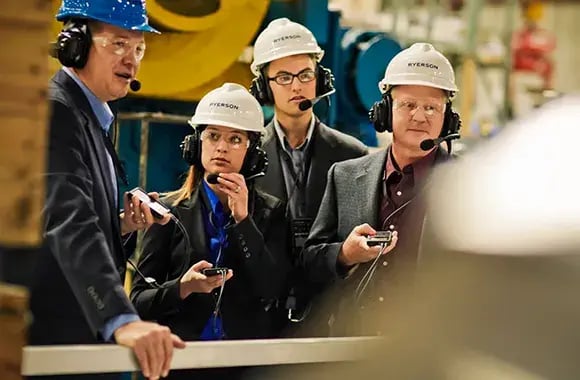
Noise on a plant floor is rarely constant. It spikes near certain machines, drops in offices or break areas, and shifts depending on what is running that day. Layer on top of that the safety requirements every visitor and guide has to follow, such as hard hats, safety glasses, hearing protection, and boot coverings, and you have a tour environment that behaves nothing like a typical event space.
The combination of variable noise, mandatory safety gear, and a group that has to move through active operations is why a plant tour needs its own planning process rather than a standard headset rental.
Follow this step-by-step guide to help you design a plant tour that leaves participants raving about their experience.
Step 1: Map the Route and Find Where Noise Actually Lives
The starting point is not the headset catalog. It is the route itself.
Before anything else, walk the tour in the same way a visitor would experience it, stop by stop. Note where the group will stand, how far they will be from the presenter, and whether they will be moving or stationary at each point. Then pay attention to where the noise changes.
Areas Where a Normal Speaking Voice May Not Carry
- Stamping line
- Compressor room
- Loading dock
- Machining center
Quieter Areas Within the Same Facility
- A transition hallway
- Training room
- Conference room
- Engineering workspace
Sound levels matter because the Occupational Safety and Health Administration notes that continuous exposure above certain decibel thresholds requires hearing protection, and any environment loud enough to require that kind of protection is also loud enough that a visitor will not hear an unamplified presenter clearly.<sup><a href="#footnote-1" id="footnote-ref-1">1</a></sup> If your route includes stops in noisy areas, the plan needs to treat them differently than the quieter stretches in between.
Walking the route first tells you where amplification and noise reduction are non-negotiable, and where they are simply a comfort improvement. That distinction changes everything that follows.
Step 2: Decide What the Speaker Needs and Whether Attendees Need to Talk Back
Once you know where the loud stops are, the next question is what the presenter needs so they can be heard clearly, and whether the group needs to talk back.
Audibility
This is a baseline requirement. Whoever is speaking, whether a single tour guide or a rotating group of subject matter experts, needs to be heard without shouting over machinery. That part is straightforward, and your headset provider can recommend features to ensure they are heard clearly above the noise without straining their voice.
One-Way vs. Two-Way Communication
The less obvious question is whether the tour should be interactive. A scripted walkthrough with a single guide and minimal audience interaction can often work as a one-way system, where the group simply listens as they move.
But plant tours rarely stay that simple. Visitors ask questions. Product experts hand off to one another at different points in the route. An international guest requires a language interpreter. Safety staff may need to interject if conditions change. If your tour includes any of those situations, plan for two-way from the start rather than trying to retrofit interaction into a one-way system mid-tour.
Related Article: One-Way vs Two-Way Headsets: Differences, Use Cases, and Deciding Factors
Use Case: Multi-Stop Plant Tour With Rotating Experts
A facility running a customer tour assumed a single guide could carry the whole route with a basic one-way system. In practice, three different department leads spoke at three different stops, and visitors wanted to ask each of them direct questions. The tour needed a two-way setup with clean handoffs between speakers, not a single broadcast channel.
Step 3: Choose the Right Headset for Noisy Environments
With the route mapped and the interaction level decided, equipment choice becomes much narrower and much clearer.
The following factors will likely play into your decision.
Noise Reduction Rating
This is a useful filter, but it should not be the only factor. Two headsets can carry the same rating and perform very differently once you account for how they sit under a hard hat, whether they interfere with safety glasses, and how they hold up with other required PPE gear moving in and out of different zones.
Comfort
A headset that fits comfortably for a 15-minute walkthrough can feel very different after an hour on a longer facility tour, so wear time deserves its own consideration, not just an afterthought.
Auto-Adjust Audio vs. Manual Attenuation
It is also worth knowing whether your system can adjust for varying levels automatically or if it needs to be set manually. Many modern systems automatically adjust audio levels as ambient noise changes, which works well for gradual shifts. But a facility with sharp jumps from a quiet hallway to a loud production floor in a few steps may need specific stops flagged for manual attenuation rather than relying on auto-adjustment alone.
Technical Note
An NRR rating is a starting filter, not a finish line. PPE compatibility and wear time often determine whether a headset actually works for your facility, regardless of its rating.
Related Article: Noise-Reduction vs. Noise-Canceling Headsets: What Is the Difference?
Step 4: Test Before Tour Day With Demo Walkthroughs and Settings Refinement
Even with the right equipment selected, a plant tour should never run live for the first time during the actual event.
Run a full demo walkthrough of the real route with the real equipment before the tour happens. This is where you:
- Identify which stops handle themselves on automatic settings and which ones need attenuation dialed in ahead of time
- Confirm that the headsets work under the required hard hats, glasses, and other PPE
- Practice handoffs between presenters to ensure they are clean and that no one gets cut off moving between stops in two-way setups
Skipping testing is one of the most common reasons a tour that once looked fine on a spec sheet feels rough when it is actually underway.
Related: Request a Tour Guide Demo Kit to Try in Your Environment
Step 5: Structure Groups, Stops, and Day-of Logistics
The last piece of planning has nothing to do with the headset itself and everything to do with how people move through the space.
Group Size
The size of your group should accommodate the physical space at each stop, not a single number applied to the whole tour. A stop near active machinery or in a tight walkway may only safely accommodate a small group, even if earlier stops comfortably held a much larger one. Set group sizes stop by stop rather than assuming one size fits the whole route.
Staffing
The same logic applies to staffing. Decide in advance how many product experts are needed at each stop versus how much a single guide can reasonably carry. This ties directly back to the one-way versus two-way decision made earlier, since more presenters generally means more need for clean audio handoffs.
Sequencing
Confirm the starting point, run the safety briefing, and plan how issuing hard hats, safety glasses, boot coverings, and other PPE integrates with headset distribution. You do not want your visitors juggling gear at the door.
Concluding the Tour
If the tour was designed for two-way interaction, plan whether to close with a live Q&A or a shorter debrief, depending on how much back and forth already happened along the route.
Key Takeaways
- Start with the route, not the headset. Noise is rarely uniform across a facility
- NRR rating matters, but PPE compatibility and wear time matter just as much
- One-way versus two-way is still a real decision in industrial settings, especially with multiple presenters
- Always run a demo walkthrough before tour day to confirm settings and safety gear integration
- Group size and presenter staffing should follow the physical space at each stop, not a single headcount for the whole tour
- Close with a debrief or live Q&A depending on how interactive the tour was designed to be
Ready to Plan a Facility Tour That Works in Your Environment?
You do not need to become an acoustics engineer to run a smooth plant tour. You need a plan built around your actual route, your actual noise zones, and your actual safety requirements. Our team can help you map the route, choose the right headset system, and structure groups around your space before you rent any equipment.
Contact Us
Frequently Asked Questions
What Noise-Reduction Rating Do I Need for a Plant Tour Headset?
It depends on where your loudest stops fall. Areas that require hearing protection under OSHA guidance are also loud enough to need enhanced amplification for visitors, not just a basic noise-reduction rating. Quieter stretches of the tour may need far less.
Can Headsets Be Worn With Hard Hats and Safety Glasses?
Many headsets are built to work alongside required PPE, but fit varies by design. Testing this in practice during a demo walkthrough, rather than relying on the spec sheet alone, is the best way to confirm compatibility.
Demo Kit Note
Implecho offers free demo kits to help you test a system in your real environment.
Should a Plant Tour Be One-Way or Two-Way?
A single guide leading a scripted walkthrough with little interaction can often work as one-way. Tours with multiple presenters, live Q&A, or hands-free needs at different stops usually call for two-way or multi-channel audio.
How Many Product Experts Should Be at Each Stop on a Facility Tour?
This depends on the complexity of each stop and how much a single guide can reasonably cover. More presenters generally means the tour needs a system built for clean handoffs between speakers.
Do We Need a Demo Walkthrough Before the Actual Tour?
Yes. A demo walkthrough on the real route with the real equipment is the best way to catch settings that need manual adjustment and to confirm PPE compatibility before the tour runs live.