


How To Choose The Best Tour Guide System For a Manufacturing Tour
If you ask me what the best tour guide system is for a manufacturing facility, my answer is usually the same: it depends on the facility.
That may not be the simplest answer, but after working with manufacturing tours in many different environments, I don't believe there is one system or headset that is right for every plant.
That's why Implecho offers multiple tour guide system brands and headset configurations. We aren't starting with one product and trying to make it work for every facility. We start with the environment and how the tour needs to work, then determine which technology makes the most sense.
If you're evaluating a tour guide system for your manufacturing or factory tours, these are the questions I recommend answering first.
- How Loud is the Manufacturing Environment?
- Do Participants Need to Listen or Participate?
- What PPE Are Visitors Wearing?
- How Many People Are Touring?
- Will Multiple People Be Presenting?
- Will Multiple Tours Happen at the Same Time?
- Do You Need Language Interpretation?
- Should You Purchase or Rent a Factory Tour Guide System?
- How Much Does a Factory Tour Guide System Cost?
Start With the Facility, Not the Headset
One of the most common mistakes I see is starting the process by comparing individual headset models.
Before we talk about equipment, I want to understand the tour.
1. How Loud Is the Manufacturing Environment?
Noise is usually one of the first things we evaluate.
In a quieter warehouse, distribution center or production environment, the biggest communication challenge may simply be distance. The people standing next to the guide can hear, but the people 20 feet behind them cannot.
A lightweight wireless tour guide system can solve that problem by putting the guide's voice directly into every participant's headset.
On a louder manufacturing floor, headset selection becomes much more important. Participants may need an over-the-ear configuration that provides greater isolation from surrounding noise.
What if your environment requires hearing protection?
We may recommend an NRR-rated headset designed to provide both communication and hearing protection. Just because a headset makes the guide easier to hear doesn't automatically mean it provides hearing protection, so be sure to ask whether there are Noise Reduction Rating (NRR) options if needed.
This is a great example of why I don't believe in recommending the same tour system for every plant. The communication requirement might sound identical — we need visitors to hear the guide — while the right equipment can be completely different.
2. Do Participants Need to Listen or Participate?
The next question is whether communication needs to be one-way or two-way.
One-way Tour Guide Systems
One-way systems are suitable if participants simply need to hear the guide. The guide speaks through a microphone, and everyone in the group hears that audio through their wireless receiver and headset.
For many factory tours, that's exactly what is needed.
Two-way Tour Guide Systems
Manufacturing tours are increasingly about more than walking visitors through a production floor. Companies are hosting customers, prospective clients, employees, dealers, partners, executives and other stakeholders. Those groups often have questions.
Instead of waiting until the group leaves the production floor to ask a question, participants can communicate with the guide while they're looking at the equipment, process or technology they're asking about.
Neither the one-way or two-way approach is universally better.
If the goal is primarily to deliver information efficiently to a large group, one-way may be the better choice. If interaction, education and discussion are central to the tour, two-way communication may be worth prioritizing.
The system should follow the purpose of the tour.
RELATED: One-way vs. Two-way Headsets: What's the Difference?
3. What PPE Are Visitors Wearing?
This question can eliminate certain headset options very quickly.
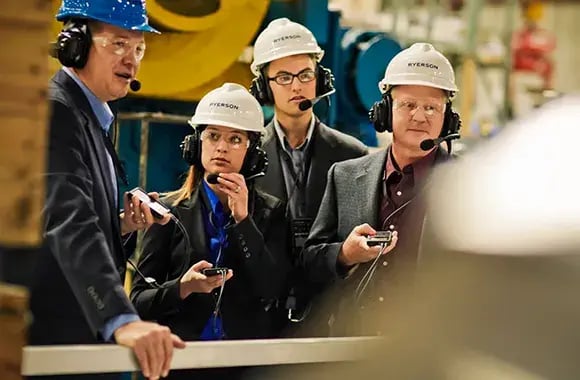
If visitors must wear hard hats, traditional headband-style headphones may not work well. If they're also wearing safety glasses and hearing protection, comfort and fit become even more important.
We look at how the communication equipment will actually work with the PPE required by the facility.
That may mean choosing a hard-hat-compatible headset, an over-the-ear NRR-rated option or a different configuration entirely.
This is also an area where having multiple system and headset options is important. There isn't one universal headset configuration that works comfortably with every combination of PPE.
Don't Overlook Headset Comfort
Visitors may wear their headset equipment for an hour or longer. A technically compatible headset isn't necessarily the best headset if participants are constantly adjusting it throughout the tour. Request a demo to evaluate a headset's comfort level.
4. How Many People Are Touring?
Group size affects more than the number of receivers you need.
For a tour of 10 or 15 people, one guide and one group may be straightforward.
Now imagine an open house or customer event with 150 visitors.
Instead of one large group, you may have several guides moving through different areas of the facility at the same time. Each group needs to hear its own guide without hearing another group's conversation.
That's when we start thinking about channels, group assignments and how the equipment will be distributed and collected.
Communication technology matters, but so does the workflow around it.
For larger manufacturing events, the best solution may be the one that makes it easiest to manage the entire experience, not simply the system with the longest list of features.
5. Will Multiple People Be Presenting?
Many manufacturing tours aren't led by one person from beginning to end.
- A safety leader may welcome the group
- An operations manager may explain production
- An engineer may take over at a specific process
- Another subject matter expert may speak at the next stop
If that's how your tour works, tell your tour guide system provider.
Some systems make it much easier to support multiple presenters within the same group. Depending on the technology, presenters can communicate to the same participants without physically handing one microphone back and forth.
It's a relatively small detail that can make a tour feel significantly more polished.
6. Will Multiple Tours Happen at the Same Time?
During a typical week, you may only host one visitor group.
During a customer event, open house, executive visit or other large program, you might suddenly have four, six or ten groups touring simultaneously.
The system needs to support separate communication groups without interference.
But technology is only part of the planning. You'll also need answers to the following questions:
- How will guests know which group they're in?
- How will equipment be assigned?
- Where will participants pick up their headsets?
- How will you collect and recharge equipment between groups?
- How will one presenter hand off a group to the next?
For a 20-person plant tour, those questions may barely matter. At 200 people, they can determine whether the experience feels organized or chaotic. An experienced headset provider can walk you through how to handle any scenario.
7. Do You Need Language Interpretation?
Manufacturing is global, and facility tours increasingly are too.
Customers, employees and partners may not all speak the same language.
If interpretation is needed, include that requirement when selecting the tour guide system rather than trying to layer interpretation onto the experience afterward.
Depending on the system and tour design, it may be possible to support different languages or interpretation workflows within the same overall communication platform.
Again, this is why we start by understanding the experience. A system that is perfect for an English-only customer tour may not be the best choice for a facility regularly hosting international visitors.
RELATED: The Importance of Language Interpretation Headsets
8. Should You Rent or Purchase a Factory Tour Guide System?
There isn't a universal answer here either.
If you host plant tours regularly for customers, employees, recruits or partners, purchasing may make sense. The equipment is onsite and available whenever your team needs it.
If you're hosting an annual open house, major customer event or occasional VIP visit, renting may be more practical.
Some manufacturers do both, owning enough equipment to support their typical tours and renting additional systems when they have a larger event or need a different configuration.
Here's a breakdown that can help:
Should You Rent or Buy a Tour Guide System?
| Option | Best Fit | Why It May Make Sense |
|---|---|---|
| Purchase | Regular plant tours for customers, employees, recruits or partners | Equipment stays onsite and is available whenever your team needs it |
| Rent | Annual open houses, major customer events or occasional VIP visits | Provides equipment when you need it without purchasing a system that sits idle most of the time |
| Own + Rent | Regular tours plus occasional larger or VIP events | Own enough equipment for typical tours, then rent additional systems when you need more units or a different configuration |
When helping a customer make the decision, I don't look only at the upfront equipment cost. I also consider:
- How often the system will be used
- How many people typically tour
- Whether requirements change from one tour to another
- Who will manage, charge and maintain the equipment
9. How Much Does a Factory Tour Guide System Cost?
This is one of those questions where the most accurate answer is ubiquitous: it depends.
A system for 15 people touring a relatively quiet warehouse is not going to be configured the same way as equipment for 100 visitors on an active production floor wearing hard hats and hearing protection.
Some of the biggest factors affecting cost include:
- Number of participants
- One-way versus two-way communication
- Headset style
- Noise level and hearing-protection requirements
- Hard-hat and PPE compatibility
- Number of guides or presenters
- Number of simultaneous groups
- Interpretation requirements
- Rental duration
- Purchase versus rental
- Charging and storage requirements
- Onsite technical support
That's why I recommend defining the tour requirements before comparing quotes.
Two systems with very different prices may also be solving two very different problems.
Why Having More Than One Tour Guide System Option Matters
This is something I believe strongly.
Implecho works with multiple professional tour guide system brands and a wide range of headset configurations because manufacturing environments aren't all the same.
Our job isn't to start with a particular system and work backward.
It's to understand the facility, the audience and the purpose of the tour, then recommend the system and headset configuration that fits.
Our extensive experience working with manufacturing and plant tours is particularly valuable because we understand that a factory tour isn't simply an AV application. Communication has to work within the realities of an active facility.
Explore Manufacturing Plant Tour Headset Solutions
What Is the Best Tour Guide System for a Manufacturing Plant?
The best tour guide system is the one that fits your facility and tour goals.
For a quieter environment where visitors simply need to hear the guide, that may be a lightweight one-way wireless system.
For an interactive customer or educational tour, two-way communication may make more sense.
For loud production environments, you may need a headset designed specifically for high-noise conditions. If hearing protection is required, look at NRR-rated options and make sure the equipment works with your existing PPE requirements.
For larger programs, consider how the system handles multiple guides, groups and channels.
And if you host tours frequently, evaluate whether purchasing, renting or a combination of both makes the most sense.
The important thing is not to assume the system that works for another manufacturing facility is automatically the right one for yours.
The best way to determine the right system is to work with a headset expert who can help you answer every question so you feel confident in your decision. You can even request a demo. Contact the Implecho team today to get started.
Key Takeaways
- There isn't one best tour guide system for every manufacturing facility. Noise level, PPE, group size, interaction, interpretation and the frequency of your tours all influence which technology will work best.
- Start with the facility and the tour experience before comparing individual products.
- One-way systems can be ideal when participants simply need to hear the guide.
- Two-way systems can add significant value when questions and interaction are part of the experience.
- For high-noise environments, determine whether you need better audio clarity or actual NRR-rated hearing protection. They're not the same thing.
- For larger manufacturing events, consider multiple tour groups, presenters, channels and equipment logistics in addition to the headsets themselves.
- Most importantly, look for a solution that gives you options. Your facility shouldn't have to adapt its tour to fit a particular piece of technology. The technology should fit the way you want your tour to work.

You May Also Like
These Related Stories

Implecho Tours That Support Training
When we think about facility tours, we often think about customers, prospects ......
Implecho Tours That Support Sales Process
When a prospective customer visits your facility, they are rarely there to see ......
How Tour Guide Systems Actually Work
And why intentional design makes the experience feel effortless When a tour ......
We're Here to Help Guide You
